Yes, emergency blankets can help reduce heat loss in freezing temperatures, but they are not enough on their own to keep someone safely warm in severe cold. Mylar emergency blankets can reflect thermal radiation and act as barriers against wind and moisture. However, they provide very little conventional insulation and do not generate heat.
Whether an emergency blanket helps in freezing weather depends on how it is used, the clothing and insulation underneath it, wind exposure, moisture, and how long someone remains in the cold.
The bottom line: A Mylar emergency blanket is a useful addition to a cold-weather survival kit, but it should be combined with dry insulating layers, protection from the ground, and shelter.
How Does an Emergency Blanket Actually Work in Cold Weather?
Mylar emergency blankets are made from thin polyester film with a reflective metallic coating. They are lightweight, compact, and commonly carried in hiking packs, vehicle emergency kits, and survival supplies.
They can help limit heat loss in several ways, but understanding their limitations is important.
Reflecting Radiant Heat
Your body constantly emits thermal radiation.
The metallic coating on a Mylar blanket has low emissivity, which can reduce radiant heat transfer when there is an appropriate air space between the reflective surface and the body or surrounding clothing.
This is why emergency blankets are often calledspace blankets orthermal blankets.
However,reflecting radiant heat is not the same as retaining 90% of all body heat.
Your body also loses warmth through moving air, direct contact with cold surfaces, and evaporation.
A scientific review published inWilderness & Environmental Medicine,Prehospital Use of Ultrathin Reflective Foils, explains that the reflective benefit may be relatively small when a person is already wearing substantial insulation.
Blocking Wind
Wind removes the warmer air surrounding your clothing and skin.
A Mylar blanket can serve as a wind barrier when wrapped around the body or used as an outer covering.
In freezing weather, reducing wind exposure can be particularly valuable.
However, loose edges, tears, and gaps can allow cold air to enter. A flat emergency blanket also needs to be secured so wind does not blow it away.
Providing a Moisture Barrier
The Mylar film itself resists water penetration, making it useful as an emergency outer barrier against rain or snow.
That does not mean wrapping yourself in Mylar automatically keeps you dry.
Openings can allow water inside, and moisture from perspiration may condense beneath the material.
The blanket works best as part of a system that also includes dry clothing and appropriate shelter.
What Mylar Does Not Do
An emergency blanket does not produce warmth like a heater.
It also lacks the thick, air-trapping insulation found in winter jackets, insulated sleeping bags, and sleeping pads.
This distinction becomes increasingly important as temperatures fall.
For a more detailed explanation, readHow Long Do Emergency Blankets Keep You Warm?.

Do Emergency Blankets Work Below 32°F (0°C)?
Yes, a Mylar emergency blanket can still help reduce heat loss below freezing. The reflective material does not suddenly stop working when the temperature drops below 32°F.
However, freezing temperatures create conditions in which the blanket's limitations become more serious.
For example:
-
At 32°F with little wind: A blanket may provide useful additional protection, especially when combined with dry clothing and insulation.
-
Below freezing with strong wind: Wind exposure and gaps around the blanket can significantly reduce its usefulness.
-
Below freezing with wet clothing: Moisture can accelerate heat loss, even when a reflective blanket is wrapped around the body.
-
Below freezing while sitting or lying on the ground: Heat can continue escaping into the cold surface beneath you.
These are examples of changing conditions,not temperature ratings or guarantees of safety.
There is no universal outdoor temperature at which a thin Mylar blanket becomes sufficient protection by itself. A person's condition, clothing, shelter, and exposure time all matter.
Can an Emergency Blanket Keep You Warm at 20°F, 10°F, or 0°F?
It may help reduce some heat loss at any of those temperatures, but that does not mean it can keep someone safely warm.
At 20°F, 10°F, or 0°F, a person may require substantial insulation and reliable shelter. Wind, wet clothing, and prolonged exposure can make the situation dangerous.
A standard emergency blanket should never be treated as a substitute for cold-weather clothing or a properly rated sleeping system.
The key distinction is between helping reduce heat loss and providing enough protection to remain safe.
Why Do You Still Feel Cold Under an Emergency Blanket?
There are several reasons someone may feel cold even after wrapping themselves in Mylar.
1. The Blanket Does Not Generate Heat
A reflective blanket can only help slow the loss of existing warmth.
If a person is already severely chilled, a thin Mylar sheet cannot rapidly restore normal body temperature.
Someone experiencing hypothermia needs prompt medical attention and appropriate warming measures.
2. Wet Clothing Continues to Cause Heat Loss
Wet clothing loses much of its ability to trap insulating air.
Moisture can also contribute to heat loss through evaporation.
Wrapping Mylar around wet clothing does not eliminate these problems and may trap additional moisture.
Whenever possible, replace wet clothing with dry layers before adding an emergency blanket.
3. Wind Enters Through Openings
A flat blanket can leave gaps around the shoulders, legs, and sides.
Cold air moving through those openings reduces the effectiveness of the wrap.
Overlapping the edges and protecting the person from wind can help.
4. Cold Ground Pulls Heat Away
Lying directly on frozen ground, snow, or a cold vehicle floor can cause substantial conductive heat loss.
A thin reflective sheet provides little protection against direct contact with those surfaces.
An insulated sleeping pad or another appropriate insulating layer underneath the body is much more useful.
5. Condensation Builds Up
Because Mylar is not breathable, moisture can collect on the inside.
In freezing conditions, condensation may even freeze on the material.
The scientific review inWilderness & Environmental Medicine identifies condensation and freezing as factors that can reduce reflective performance.
This is another reason not to rely on Mylar as the only layer of protection.
What Makes the Biggest Difference in Freezing Conditions?
When using an emergency blanket in freezing weather, prioritize the entire warming system rather than the blanket alone.
First: Find Shelter
Getting out of wind, rain, and snow should be a priority.
A vehicle, building, tent, or suitable emergency shelter can reduce environmental exposure.
If you are stranded outdoors, seek a protected location while avoiding hazards such as unstable terrain or falling branches.
Second: Use Dry Insulating Layers
Insulated clothing helps trap air close to the body.
Wear appropriate layers, including a warm hat, gloves, and dry socks.
When available, replace wet clothing with dry clothing before wrapping yourself in Mylar.
Third: Insulate Yourself From the Ground
Use a sleeping pad or another suitable dry insulating barrier underneath your body.
Ground insulation is especially important when sitting or lying down.
A reflective blanket draped over the top of your body cannot compensate for inadequate insulation underneath.
Fourth: Add the Mylar Blanket as a Protective Layer
Wrap the emergency blanket around the body over appropriate clothing and insulation.
Overlap the edges to reduce drafts, but do not compress insulating layers excessively.
Keep the nose and mouth uncovered.
A Mylar blanket can also serve as an outer barrier when additional blankets or insulation are available.
Fifth: Reduce Exposure Time
The longer someone remains in freezing conditions, the greater the potential danger.
Seek a reliably heated environment or appropriate rescue assistance as soon as possible.
Do not use a Mylar blanket as justification for remaining outdoors longer than necessary.
Remember: Shelter, dry insulation, ground protection, and exposure time can matter more than the reflective surface itself.
For practical instructions, seeHow to Use an Emergency Blanket: A Step-by-Step Guide.

Is a Flat Emergency Blanket or an Enclosed Emergency Sleeping Bag Better in Freezing Weather?
Both designs can be useful, but they serve slightly different purposes.
A flat Mylar emergency blanket is versatile. It can be wrapped around a person, used as an outer weather barrier, or incorporated into a temporary shelter.
An enclosed Mylar emergency sleeping bag, often called an emergency bivy, surrounds more of the body and can reduce some of the openings that allow wind to enter.
Flat Blanket vs. Emergency Sleeping Bag
| Feature | Flat Mylar blanket | Mylar emergency sleeping bag |
|---|---|---|
| Body coverage | Wraparound sheet | Enclosed design |
| Wind protection | Depends on how edges are secured | Can reduce gaps around the body |
| Versatility | Useful for wrapping, barriers, and shelter applications | Primarily intended for enclosed body coverage |
| Portability | Very compact | Also compact |
| Conventional insulation | Very limited | Very limited |
| Suitable alone for freezing-weather sleeping | No | No |
Which Is Better for Cold-Weather Emergencies?
An enclosed emergency sleeping bag can be more convenient when the goal is to maintain coverage around one person.
Its shape may help reduce drafts compared with a loosely wrapped flat blanket.
However,an enclosed Mylar bivy is not automatically warmer in every situation. Material construction, fit, wind exposure, moisture, and insulation underneath all affect performance.
Neither design should be confused with an insulated sleeping bag rated for winter conditions.
Mart Cobra Emergency Blankets and Sleeping Bags
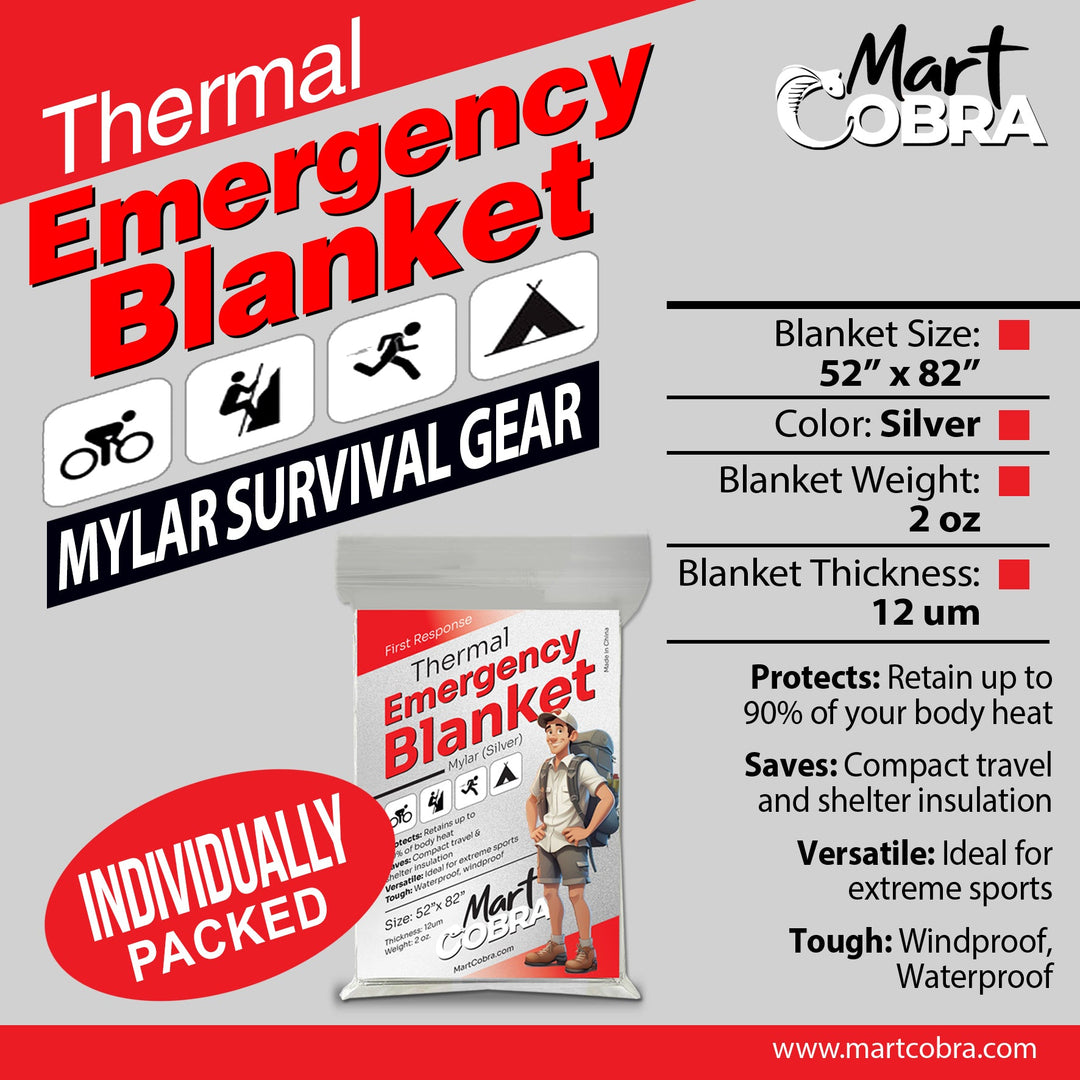
TheMart Cobra Mylar Emergency Blanket is a compact reflective sheet measuring approximately82 × 52 inches, suitable for storage in vehicle kits, backpacks, and household emergency supplies.
For people who prefer enclosed coverage, theMart Cobra Emergency Sleeping Bag offers a lightweight Mylar bivy-style alternative.
Both are designed as compact emergency preparedness supplies rather than replacements for conventional cold-weather insulation.
For a more detailed comparison, readEmergency Blanket vs. Emergency Sleeping Bag: What's the Difference?.
What Are the Warning Signs of Hypothermia?
Hypothermia occurs when the body loses heat faster than it can maintain its normal temperature.
It can develop during freezing weather, but it can also occur above freezing when someone is wet and chilled.
According to theCenters for Disease Control and Prevention, warning signs in adults include:
-
Shivering
-
Exhaustion or unusual weakness
-
Confusion or memory problems
-
Fumbling hands or poor coordination
-
Slurred speech
-
Drowsiness
Suspected hypothermia is a medical emergency.
Call emergency services if someone shows concerning symptoms. Do not wait for a temperature measurement before seeking help.
While waiting for assistance, move the person into shelter if it is safe to do so, replace wet clothing with dry layers, and help reduce further heat loss.
Follow emergency-dispatch instructions for warming and care.
Do not give alcohol, and do not give drinks to someone who is unconscious or unable to swallow safely.
A Mylar emergency blanket may be used as an additional protective layer, but it does not replace medical treatment.
What Should a Cold-Weather Emergency Kit Include?
A practical cold-weather emergency kit should address several different needs.
Warmth and Insulation
-
Warm jacket or insulating layers
-
Hat, gloves, and extra socks
-
Conventional blanket or insulated sleeping bag
-
Sleeping pad or other suitable ground insulation
-
Mylar emergency blankets
-
Optional enclosed Mylar emergency sleeping bag
Shelter and Weather Protection
-
Appropriate rain or wind protection
-
Emergency shelter or tarp, when suitable
-
Dry storage bags for clothing and supplies
Communication and Safety
-
Flashlight or headlamp with batteries
-
Whistle or other signaling device
-
Charged phone and backup power
-
First-aid supplies
-
Water and suitable nonperishable food
For a vehicle kit, add equipment appropriate to local winter driving conditions.
TheNational Weather Service recommends carrying extra clothing and blankets as part of winter preparedness.
For additional ideas, seeWhat Should You Keep in a Car Emergency Kit? andWhat Should You Keep in a Family Emergency Kit?.
Do Emergency Blankets Expire or Stop Working After One Use?
A conventional Mylar emergency blanket does not automatically stop working after a single use.
However, its condition matters.
Thin reflective film can develop tears, punctures, worn folds, or damage to its metallic coating. Repeated handling may also make the blanket harder to wrap securely.
Before relying on a stored emergency blanket, check for:
-
Tears or holes
-
Damaged seams, if applicable
-
Significant deterioration of the reflective coating
-
Contamination or moisture damage
-
Packaging damage that may have exposed the blanket to wear
A blanket that remains intact may be reusable, but a heavily damaged one should be replaced.
There is no universal expiration date that applies to every Mylar emergency blanket. Follow any storage or replacement guidance provided by the manufacturer.
For an emergency kit, keeping an unused backup can be sensible because these blankets are compact and lightweight.
Frequently Asked Questions
Do Emergency Blankets Work in Snow?
They can help reduce heat loss and act as a barrier against wind and moisture, but snow exposure requires appropriate shelter, dry clothing, and insulation.
Can You Sleep Outside in Freezing Weather With Only a Mylar Blanket?
No. A thin Mylar emergency blanket is not a safe substitute for an insulated cold-weather sleeping system. Freezing conditions can become dangerous without adequate insulation and shelter.
Do Emergency Blankets Work at 0°F?
The material can still act as a reflective and wind-resistant barrier, but that does not mean it provides enough protection at 0°F. Never rely on a thin emergency blanket alone at that temperature.
Are Emergency Sleeping Bags Warmer Than Emergency Blankets?
An enclosed Mylar emergency sleeping bag may reduce drafts more effectively than a loosely wrapped flat blanket, but neither provides the substantial insulation of a conventional sleeping bag.
Which Side of a Mylar Blanket Should Face Your Body in Freezing Weather?
For a typical double-silver Mylar blanket, either side can generally face inward. Proper wrapping, dry insulation, and shelter matter much more.
Learn more inWhich Side of a Mylar Emergency Blanket Should Face Your Body?.
Can an Emergency Blanket Prevent Hypothermia?
An emergency blanket can be one component of reducing heat loss, but it cannot guarantee prevention of hypothermia. Adequate insulation, shelter, and timely medical care remain essential.
Key Takeaways
-
Yes, Mylar emergency blankets can help reduce heat loss below freezing, but they are not sufficient protection on their own.
-
Reflective film can reduce radiant heat transfer and serve as a barrier against wind and moisture.
-
Thin Mylar provides very little conventional insulation and does not generate heat.
-
Wet clothing, wind, condensation, and cold ground can substantially reduce the effectiveness of an emergency blanket.
-
Enclosed Mylar emergency sleeping bags may reduce drafts, but they are not substitutes for insulated sleeping bags.
-
There is no universal temperature rating or safe exposure time for a standard emergency blanket.
-
Confusion, slurred speech, and poor coordination in cold conditions may indicate hypothermia and require urgent medical attention.
Final answer: Emergency blankets do work in freezing temperatures in the limited sense that they can help slow heat loss. Their greatest value is as a compact backup layer within a broader cold-weather survival system—not as a standalone solution for severe cold.
References
-
Kosiński et al. — Prehospital Use of Ultrathin Reflective Foils.Wilderness & Environmental Medicine, 2022. Review of heat-transfer mechanisms, practical limitations, and the role of reflective foils.
-
Centers for Disease Control and Prevention — Preventing Hypothermia. Guidance on recognizing hypothermia and responding to cold exposure.
-
National Weather Service — Winter Weather Safety. Winter preparedness guidance, including extra clothing, blankets, and vehicle emergency supplies.