Are emergency blankets reusable? Yes, many Mylar emergency blankets can be reused if they remain in good condition. However, there is no universal number of uses that applies to every blanket. Whether you can use one again depends on the material, how it was handled, and whether it has developed tears, punctures, or significant surface damage.
A blanket used carefully during a short emergency may still be suitable afterward. One dragged across rough ground or damaged while being unfolded might need replacing after its first use.
The important question isn't simply how many times you've used your emergency blanket. It's whether the blanket is still dependable when you need it.
This guide explains how reuse works, what damage to look for, how to clean and store an opened blanket, and when replacement makes more sense.
What Does Reusable Mean for a Mylar Emergency Blanket?
Mylar emergency blankets are lightweight sheets made from thin, reflective plastic film.
Unlike conventional blankets, which depend largely on trapped air within their fibers for insulation, reflective emergency blankets help reduce radiant heat loss. Their film also provides a barrier against wind and external moisture when intact.
For more information about the material, see our guide toMylar blankets vs. space blankets.
When we describe an emergency blanket as reusable, we mean that it may be unfolded, used, and stored for another occasion without becoming too damaged to function.
That doesn't mean the blanket is designed for unlimited use.
A thin emergency blanket can remain intact after careful handling, but the material can also tear when pulled against sharp or rough surfaces.
Reusable means the blanket may be used again if its condition allows—not that every blanket has a guaranteed number of uses.
How Many Times Can You Reuse an Emergency Blanket?
There is no scientifically established number of uses for all Mylar emergency blankets.
Some blankets may remain usable after several careful deployments. Others may be damaged during their first use.
The number depends on several factors:
-
Material thickness and construction
-
How carefully the blanket is unfolded
-
Whether it contacts rough or sharp surfaces
-
How much pulling or stretching occurs
-
How the blanket is cleaned and stored
-
Whether it has already developed damage
You may encounter claims that standard emergency blankets last two or three uses or that heavier blankets last ten or more.
Those figures should not be treated as universal durability ratings. Without standardized testing for a specific product, they are not reliable guarantees.
Can You Reuse a Blanket After One Use?
Yes, potentially.
If you used an emergency blanket briefly, kept it away from sharp objects, and found no significant damage afterward, it may still be suitable for another use.
Inspect it before repacking and again before relying on it.
Can You Reuse the Same Blanket Multiple Times?
Possibly, but repeated handling increases opportunities for damage.
Even if a blanket looks fine after one use, don't assume it will remain dependable indefinitely.
For emergency preparedness, condition matters more than keeping count.
What Makes Some Emergency Blankets More Durable Than Others?
Not all reflective emergency blankets have identical construction.
Several characteristics influence how well they withstand handling.
Material Thickness
Thin plastic film is what makes conventional emergency blankets so lightweight and compact.
However, thinner material can be easier to puncture or tear.
Heavier constructions may resist some forms of physical damage better, although thickness alone doesn't establish how many uses a blanket will survive.
Reinforcement and Construction
Some reflective blankets use reinforced materials or additional backing.
These designs may tolerate rough handling better than a basic, lightweight emergency sheet.
However, heavier construction also changes the blanket's weight, bulk, and intended applications.
How the Blanket Is Used
A blanket wrapped loosely around someone's shoulders is exposed to different stresses than one stretched tightly between trees or placed directly on rocky ground.
Using a thin blanket as a makeshift shelter, tarp, or ground cover can create more opportunities for punctures and tears.
Those uses may be practical in an emergency, but the blanket should be inspected afterward before being stored for future protection.
Storage Between Uses
A blanket stored in a protected bag is less likely to experience accidental damage than one left loose among tools or camping equipment.
Good storage doesn't guarantee unlimited durability, but it reduces avoidable wear.
Do Wrinkles, Creases, and Folding Make Emergency Blankets Less Effective?
One of the most common concerns about reusing emergency blankets is the appearance of wrinkles.
When you unfold a Mylar blanket, you'll notice that the material is already heavily creased from its compact packaging.
Normal wrinkles and fold lines do not automatically mean an emergency blanket has stopped working.
The more important question is whether the material remains intact.
Normal Wrinkles
Wrinkles are expected in thin reflective film.
A blanket can look crinkled without having large tears, holes, or obvious coating damage.
There's no reason to discard a blanket simply because it no longer looks perfectly smooth.
Repeated Folding
Repeated folding and handling can create opportunities for abrasion and physical stress.
Try to avoid unnecessarily pulling the film tight or forcing it around sharp objects.
If you notice tears developing along fold lines, replacement is sensible.
Surface Damage
Significant scratching, peeling, or widespread damage to the reflective surface is more concerning than ordinary wrinkles.
A visual inspection can identify obvious problems, although it cannot precisely measure remaining thermal performance.
Can You Reuse an Emergency Blanket After It Gets Wet?
An emergency blanket that gets wet isn't automatically ruined.
The plastic film itself is designed to resist liquid water when intact.
However, moisture can remain trapped in folds or collect on clothing and other materials beneath the blanket.
Before storing a previously used blanket:
-
Unfold it carefully.
-
Remove visible dirt or debris.
-
Allow the material to dry completely.
-
Inspect it for punctures, tears, and significant surface damage.
-
Repack it in a clean, protective bag.
Don't store a damp blanket tightly folded with other emergency supplies.
What About Rain or Snow?
An intact Mylar emergency blanket can serve as a temporary barrier against rain, snow, and wind.
However, it is not a substitute for appropriate cold-weather clothing or insulated shelter.
TheCDC's cold-weather guidance emphasizes staying dry, removing wet clothing, and using dry insulating layers when someone is dangerously cold.
If your blanket was used during a storm, inspect it after the emergency rather than assuming the weather alone made it unusable.

How to Clean an Emergency Blanket Before Reusing It
Cleaning should be gentle because conventional Mylar emergency blankets are made from thin film.
For light dirt or ordinary surface moisture, a simple approach is usually sufficient.
Step 1: Remove Loose Debris
Gently shake off loose dirt or debris.
Avoid dragging the blanket across rough surfaces.
Step 2: Wipe Carefully
If cleaning is necessary and the manufacturer's instructions allow it, use a soft cloth lightly dampened with water.
Avoid aggressive scrubbing, harsh chemicals, and abrasive cleaning tools.
Step 3: Dry Completely
Spread the blanket out in a clean, protected area and let it air-dry.
Avoid exposing it to unnecessary high heat.
Step 4: Inspect for Damage
Once dry, check for tears, punctures, damaged coating, and contamination.
If the blanket has been exposed to blood, bodily fluids, or other potentially hazardous substances, replacing it is generally more practical than attempting to sanitize a thin emergency sheet.
Step 5: Repack for Storage
Fold the blanket gently and place it in a clean protective bag.
It may not return to its original factory-folded size, and that's okay.
Important: These are general handling suggestions, not a manufacturer-validated cleaning procedure. Follow any specific care instructions provided with your blanket.
When Should You Stop Reusing an Emergency Blanket?
Knowing when to replace a blanket is just as important as knowing how to reuse one.
The following conditions are practical reasons to retire an emergency blanket from dependable emergency use.
| Condition | Recommended action |
|---|---|
| Normal wrinkles and creases | Usually acceptable if otherwise intact |
| Small isolated puncture | Assess damage; replacement is safer when dependable coverage is needed |
| Large tears or multiple holes | Replace |
| Significant reflective surface damage | Replace |
| Extensive stretching or material separation | Replace |
| Blood or hazardous contamination | Replace |
| Material that tears easily during gentle handling | Replace |
| Uncertain condition | Replace before relying on it in an emergency |

Why Do Tears Matter?
Tears and punctures interrupt the continuous protective sheet.
They can also spread as the blanket is pulled or wrapped around someone.
A damaged blanket might still reflect some radiant heat, but that doesn't mean it provides dependable coverage against wind or moisture.
Why Does Surface Damage Matter?
A reflective emergency blanket depends partly on its metallic surface.
Extensive damage to that surface raises questions about how effectively the blanket will perform.
Without product-specific testing, you cannot reliably determine remaining performance just by looking at it.
Should You Keep a Damaged Blanket for Other Uses?
A damaged blanket may still have limited utility in certain noncritical situations, but don't mistake that for dependable emergency protection.
For example, a reflective piece of material might remain visible as a signaling aid.
It should not be treated as a reliable substitute for an intact emergency blanket when protection from cold or severe weather matters.
Do Emergency Blankets Expire?
There is no universal expiration date for all conventional Mylar emergency blankets.
An unused blanket stored carefully may remain usable for years, while one exposed to rough handling can become damaged much sooner.
Age and reuse are related, but they are not the same issue.
An older blanket that has never been opened may be in better condition than a newer one that has already been torn.
For detailed guidance on storage life and replacement, see our companion article onwhether emergency blankets expire.
The practical approach is to inspect emergency supplies periodically and replace blankets with questionable condition rather than relying on an arbitrary number of years or uses.
Is It Better to Reuse an Emergency Blanket or Replace It?
That depends on how the blanket was used and what you expect from it next.
If you used it briefly in a controlled setting and it remains intact, reusing it may be reasonable.
If it was dragged across rough ground, exposed to contamination, or damaged during a real emergency, replacement may be the better choice.
There's also a difference between using a blanket again for a casual outdoor activity and relying on it as part of an emergency kit.
For an emergency kit, dependability should take priority over getting the maximum possible number of uses from an inexpensive item.
This doesn't mean every blanket must be discarded after a single use.
It meansyou shouldn't assume a blanket is ready for another emergency without checking it first.
Why Keeping Emergency Blankets Available Matters
Emergency blankets are valuable partly because they're compact enough to keep accessible.
You can include them in vehicle emergency kits, backpacks, evacuation bags, and household emergency supplies.
If several people need protection at once, having only one blanket may not provide adequate coverage.
FEMA's emergency supply checklist recommends planning warm blankets or sleeping bags for each person as part of household preparedness.
This supports planning emergency supplies around the number of people who may need them.
For more ideas, read our guides tofamily emergency kits andcar emergency kits.
Are Mart Cobra Mylar Emergency Blankets Reusable?
Yes.Mart Cobra Mylar Emergency Blankets can be reused with care when they remain in suitable condition.
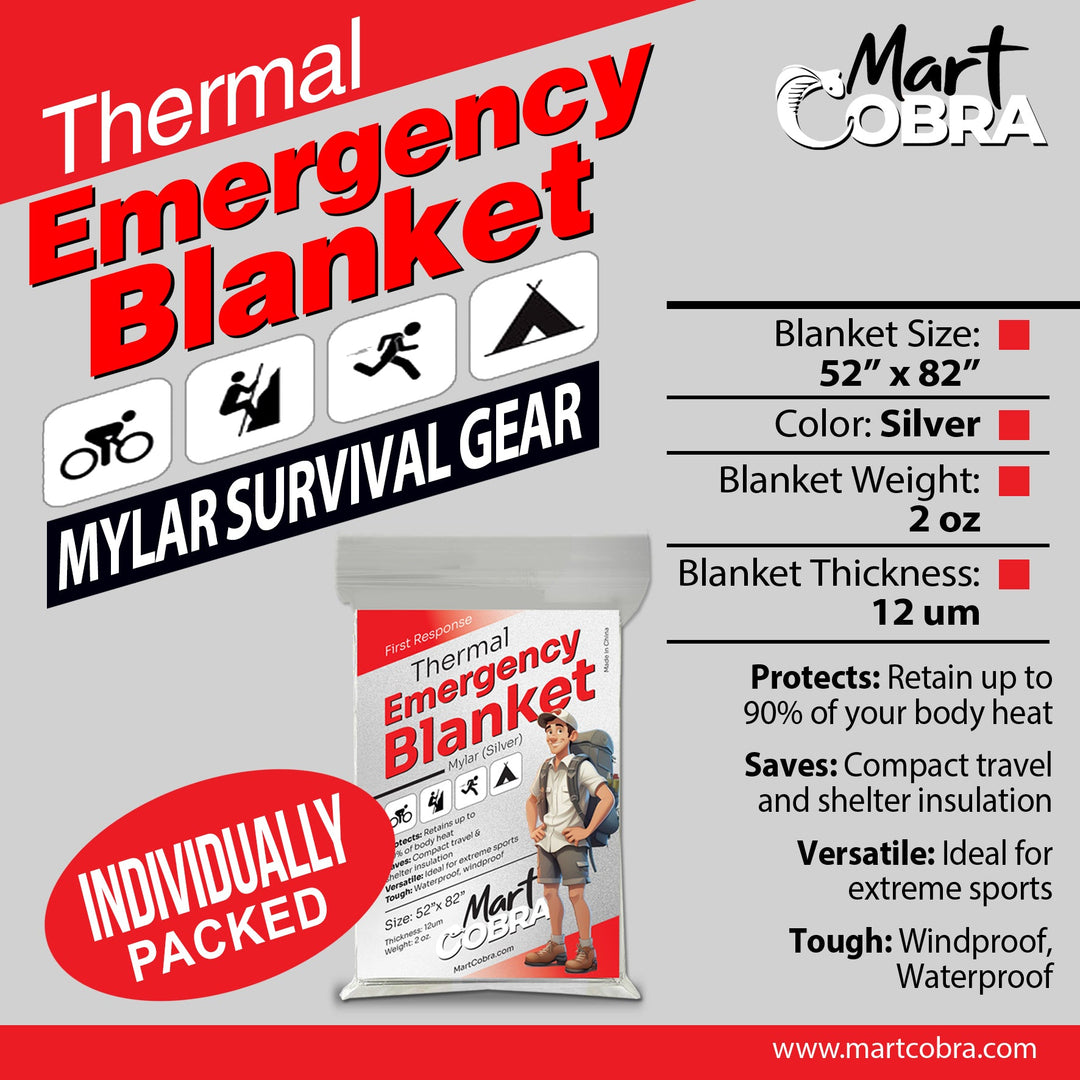
Each blanket is a lightweight reflective sheet measuring approximately 82 × 52 inches, designed for compact storage in emergency kits and other preparedness supplies.
The material provides a reflective surface and a wind- and water-resistant barrier when intact.
However, Mart Cobra's standard Mylar emergency blankets are not indestructible, and there is no guaranteed number of uses.
Inspect a previously opened blanket for tears, punctures, significant surface damage, and contamination before using it again.
If you want to keep dependable emergency supplies available for multiple family members, Mart Cobra offersemergency blankets in multi-pack options.
For practical instructions on deploying one, seeHow to Use an Emergency Blanket.
Frequently Asked Questions
Can you use a Mylar emergency blanket more than once?
Yes, if it remains intact and suitable for its intended purpose. Inspect the blanket before each reuse.
Are emergency blankets single-use?
Not necessarily. Some lightweight blankets are intended primarily for emergency deployment, but an intact blanket may still be reusable. Follow the product's instructions.
How many times can you fold an emergency blanket?
There is no established universal folding limit. Avoid rough handling and inspect for damage that develops during repeated use.
Can you wash an emergency blanket?
Gentle surface cleaning may be possible if permitted by the manufacturer. Avoid machine washing, harsh chemicals, and aggressive scrubbing unless the product specifically allows them.
Do wrinkles make Mylar blankets less effective?
Normal wrinkles aren't automatically a sign of failure. Actual tears, holes, and significant coating damage are more important concerns.
Can you reuse an emergency blanket after camping?
Possibly. Check for damage from branches, rocks, pulling, or abrasion. Replace it if the material is no longer dependable.
Can you reuse an emergency blanket after rain?
Yes, potentially. Dry it completely and inspect it before repacking. Replace it if damaged or contaminated.
Are emergency blankets enough to keep someone warm overnight?
Not by themselves in many cold-weather situations. Reflective emergency blankets are not equivalent to insulated sleeping bags. The CDC emphasizes shelter, dry clothing, and insulating layers for cold exposure.
See our comparison ofemergency blankets vs. emergency sleeping bags.
Final Thoughts: Are Emergency Blankets Reusable?
Yes, emergency blankets can sometimes be reused—but condition matters more than the number of uses.
A blanket that remains intact after careful handling may still be useful. A blanket with large tears, significant reflective surface damage, or hazardous contamination should be replaced.
Keep your blankets protected, inspect them after use, and avoid relying on damaged material during an emergency.
For households and families, having dependable emergency supplies available for everyone is more important than trying to make a single blanket last indefinitely.
References
-
CDC — Preventing Hypothermia — Official guidance on cold exposure, dry clothing, insulation, and emergency warming.
-
CDC Yellow Book — Heat and Cold Illness in Travelers — Medical discussion of heat-loss mechanisms, including radiation, convection, and conduction.
-
FEMA / Ready.gov — Emergency Supply List — Federal recommendations for emergency supplies, including warm blankets or sleeping bags for each person.
Source limitation: These references support the preparedness and thermal-safety guidance. They do not establish a specific number of safe reuse cycles for thin Mylar emergency blankets. The inspection, cleaning, and replacement recommendations are practical guidance rather than laboratory-tested reuse guarantees.