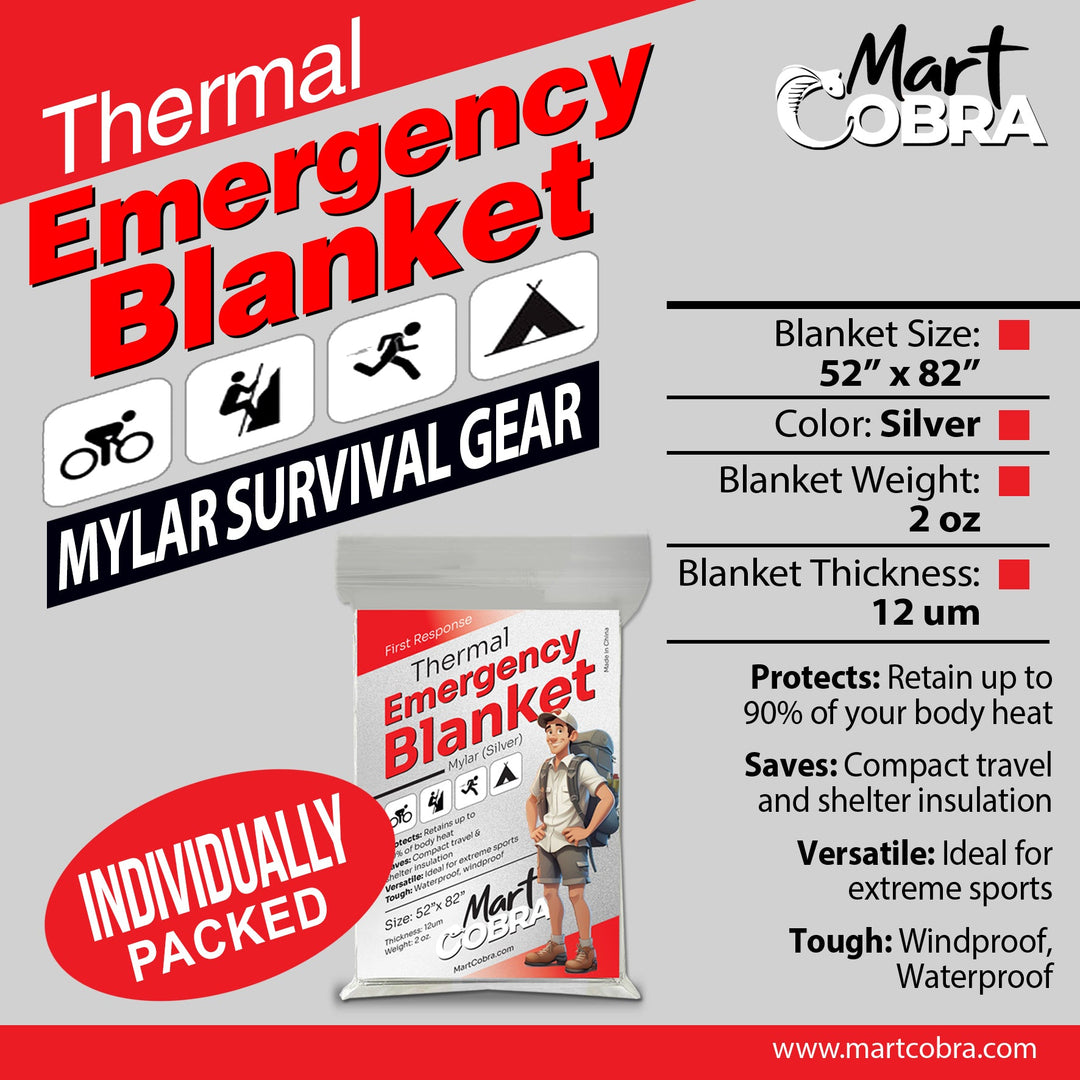
An emergency bivy and a regular sleeping bag can both help protect someone from cold, but they work differently and are designed for different situations. An emergency Mylar bivy is a lightweight, reflective, bag-shaped shelter intended for unexpected exposure. A conventional sleeping bag uses insulation to provide warmth during planned overnight use.
The biggest difference is simple:an emergency bivy helps reduce heat loss using a reflective barrier and enclosed coverage, while an insulated sleeping bag slows heat loss using layers of trapped air.
That distinction matters when choosing gear for your vehicle, emergency kit, hiking pack, or camping trip.
This guide compares emergency bivies and sleeping bags by warmth, weight, weather protection, condensation, durability, and intended use—so you can understand where each belongs in your preparedness plan.
Emergency Bivy vs. Sleeping Bag: Quick Comparison
| Feature | Mylar Emergency Bivy | Insulated Sleeping Bag |
|---|---|---|
| Primary purpose | Unexpected emergencies | Planned sleeping outdoors |
| Main material | Thin reflective film | Insulated fabric construction |
| How it works | Reflective surface and wind barrier | Trapped-air insulation |
| Temperature rating | Usually not independently rated | Often tested or temperature-rated |
| Packed size | Very compact | Generally larger |
| Weight | Usually measured in ounces | Often measured in pounds |
| Wind protection | Good when intact and properly enclosed | Depends on shell and construction |
| Moisture concerns | Condensation can accumulate inside | Moisture performance depends on materials |
| Ground insulation | Minimal | Requires an appropriate sleeping pad |
| Durability | More vulnerable to punctures and tears | Designed for repeated use |
| Best use | Emergency backup protection | Planned overnight camping |
Neither product is universally better. The right choice depends on whether you're preparing for an unexpected emergency or planning to sleep outdoors.

What Is an Emergency Bivy?
An emergency bivy—sometimes called athermal bivy,survival bivy, orMylar emergency sleeping bag—is a lightweight, bag-shaped covering made from reflective material.
Unlike a flat emergency blanket, which must be wrapped around the body, an emergency bivy provides an enclosed space for the user to enter.
This shape can make it easier to maintain coverage around the legs and torso and reduce openings through which wind can enter.
How Does a Mylar Emergency Bivy Work?
Most basic emergency bivies use thin plastic film with a reflective metallic surface.
The material can help reduce radiant heat loss and provide a barrier against wind and external moisture when intact.
However, the film itself contains very little insulating loft. It does not create the same protective layer of trapped air found in a conventional insulated sleeping bag.
An emergency bivy also does not generate heat. It relies on the user's body warmth and whatever additional insulation or shelter is available.
What Is an Emergency Bivy Designed For?
A reflective emergency bivy is especially useful when someone unexpectedly needs protection from the elements.
Examples include:
-
A vehicle breakdown during cold weather
-
An unexpected delay on a hiking trail
-
An evacuation or temporary shelter situation
-
A power outage that leaves a home without adequate heating
-
An emergency kit where storage space is limited
Its primary advantage is that it can be stored in a small package until needed.
For more about using this type of equipment, see our guide tohow to use an emergency sleeping bag.
Is Every Bivy Made from Mylar?
No.
The termbivy can also refer to a conventional camping bivy sack: a protective outer shelter, sometimes made with waterproof-breathable fabric, that surrounds a sleeping bag.
Those products are different from lightweight reflective emergency bivies.
For this comparison,emergency bivy means the thin Mylar-style emergency sleeping bag—not a technical camping bivy shelter.
How Does a Regular Sleeping Bag Keep You Warm?
A conventional sleeping bag uses insulation to slow the transfer of heat away from the body.
Most camping sleeping bags contain down or synthetic insulation between fabric layers.
The insulation creates loft, which traps air and reduces heat transfer between the sleeper and the surrounding environment.
Why Is Insulation Important?
When temperatures fall, your body continuously loses heat to its surroundings.
A sleeping bag helps reduce that loss by surrounding the body with insulating material.
Unlike thin reflective Mylar film, the insulation has physical thickness.
That thickness is particularly important during extended periods of exposure, including sleeping overnight.
However, even a well-insulated sleeping bag loses effectiveness when its insulation is compressed.
This is one reason sleeping pads are an important part of a complete cold-weather sleep system.
What Do Sleeping Bag Temperature Ratings Mean?
Many conventional sleeping bags carry temperature ratings to help buyers select equipment for expected conditions.
The international standardISO 23537-1:2022 establishes testing and labeling requirements for qualifying adult sleeping bags.
These ratings help compare thermal performance under defined test conditions.
They are not guarantees of comfort for every person, because factors such as clothing, sleeping pads, moisture, wind exposure, and individual physiology affect real-world warmth.
A basic Mylar emergency bivy generally does not have an equivalent independently tested comfort rating.
That's why a reflective emergency bivy should not replace an appropriately rated insulated sleeping bag for planned cold-weather camping.
How Do Emergency Bivies and Sleeping Bags Prevent Heat Loss?
Understanding how the body loses heat helps explain why these products are different.
There are four major heat-loss mechanisms:
-
Radiation: Heat emitted from the body toward cooler surroundings.
-
Convection: Heat carried away by moving air.
-
Conduction: Heat transferred through contact with colder objects.
-
Evaporation: Heat lost when moisture evaporates from skin or clothing.
Reflective Emergency Bivies
A reflective Mylar bivy can help reduce radiant heat transfer.
Its enclosed shape and thin film can also limit exposure to moving air and external moisture.
However, it provides little conventional insulation against conductive heat loss, particularly when someone is lying directly on cold ground.
This is why insulating material beneath the body remains important.
Insulated Sleeping Bags
A conventional sleeping bag primarily uses trapped-air insulation to slow heat transfer.
Its construction can help reduce heat loss over extended periods, provided the insulation stays sufficiently dry and maintains its loft.
A sleeping bag still needs an appropriate pad underneath it.
Why the Ground Matters
Cold ground can draw heat away from the body through conduction.
A reflective emergency bivy does not eliminate this problem.
If you're using one during an emergency, place an insulating barrier between yourself and the ground whenever possible.
A foam sleeping pad is ideal, but other available dry insulating materials may help when no pad is available.
The U.S. Air Force's hypothermia guidance recommends adding insulating materials beneath and around a cold person to reduce further heat loss.

Which Packs Smaller: An Emergency Bivy or a Sleeping Bag?
For compact emergency storage, a Mylar bivy has a clear advantage.
Because it contains little bulky insulation, it can fold into a very small package.
That makes it practical for places where a conventional sleeping bag would be inconvenient.
Emergency Bivy Storage
A compact emergency bivy can fit into:
-
Vehicle emergency kits
-
Hiking daypacks
-
Evacuation bags
-
Household preparedness supplies
-
Outdoor activity kits
A conventional insulated sleeping bag usually takes considerably more room.
What About Weight?
Weight varies by manufacturer and construction.
A thin reflective emergency bivy may weigh only a few ounces, while an insulated sleeping bag can weigh several pounds.
However, specialized lightweight camping bags can weigh considerably less than traditional sleeping bags.
For a direct example, theMart Cobra Emergency Sleeping Bag weighs approximately 4.7 ounces and is designed for compact emergency storage.
Its low weight is an advantage for preparedness, but it should not be confused with the insulation provided by a much heavier camping bag.
How Do Wind, Rain, and Condensation Affect Each Option?
Weather protection is one of the most important differences between these products.
Wind Protection
An intact Mylar emergency bivy provides a physical barrier against moving air.
Its enclosed design can reduce the gaps that sometimes occur when using a loose emergency blanket.
However, openings, tears, and movement can still allow cold air to enter.
A conventional sleeping bag's wind protection depends on its outer fabric, construction, and whether it is used inside a tent or other shelter.
Rain and Snow
Thin Mylar film resists external moisture when intact.
That can be helpful during unexpected rain or snow exposure.
However, an emergency bivy should not be treated as a complete weatherproof shelter.
Water can enter through openings or damaged areas, and the user may still be exposed to cold ground and wind.
Conventional sleeping bags vary in their water resistance. Many are designed to be used inside a tent or protected shelter rather than directly in rain.
Condensation Inside a Mylar Bivy
Condensation is an important limitation of nonbreathable reflective materials.
Water vapor from breathing, perspiration, and damp clothing can accumulate inside the enclosed space.
As the moisture contacts cooler surfaces, droplets may form.
Over time, that moisture can dampen clothing or insulation, increasing the risk of chilling.
The CDC emphasizes that wet clothing and exposure to cold can contribute to hypothermia—even when outdoor temperatures are above freezing.
Practical advice: Keep clothing as dry as possible, use shelter when available, and follow the product's instructions for safe use and ventilation. Never seal the opening over your face or obstruct breathing.
Which Is More Durable: A Mylar Bivy or a Sleeping Bag?
A conventional insulated sleeping bag is generally designed for repeated camping trips.
Its fabric shell, stitching, and insulation are built to tolerate regular handling when properly cared for.
A basic Mylar emergency bivy prioritizes low weight and compact storage instead.
Why Can Mylar Tear?
Thin reflective film can be punctured or torn by:
-
Sharp rocks or branches
-
Rough ground
-
Excessive pulling
-
Abrasion against equipment
-
Repeated rough handling
The material's compactness is an advantage, but it also means the user should handle it carefully.
Can You Reuse an Emergency Bivy?
Potentially.
A reflective emergency bivy may remain usable after a careful deployment if it has no significant damage or contamination.
However, there is no universal number of uses that applies to every product.
Inspect the material before relying on it again.
For related guidance, seeAre Emergency Sleeping Bags Reusable?.
When Should You Choose an Emergency Bivy Instead of a Sleeping Bag?
The best choice depends on the situation.
Choose an Emergency Bivy for Unexpected Emergencies
A Mylar emergency bivy makes sense when compact storage and immediate availability are the priorities.
For example, you might keep one in your vehicle so you have an additional protective layer if you're stranded during a winter breakdown.
It's also practical for hiking daypacks, evacuation bags, and household preparedness kits.
For vehicle-specific recommendations, readWhat Should You Keep in a Car Emergency Kit?.
Choose an Insulated Sleeping Bag for Planned Camping
If you're planning to sleep outdoors, select an insulated sleeping bag appropriate for the expected temperatures and conditions.
Pair it with an adequately insulated sleeping pad and suitable shelter.
A Mylar emergency bivy is not a substitute for that equipment.
What If You're Preparing for Both?
You may have good reasons to carry both.
An insulated sleeping bag serves as your primary sleeping equipment, while a compact emergency bivy can be stored separately as a contingency item.
However, using a nonbreathable Mylar bivy inside or around an insulated sleeping bag can trap moisture and potentially wet the insulation.
Don't assume that combining the two automatically improves overnight warmth. Follow manufacturer guidance and consider condensation, ventilation, and the conditions.
Where Does the Mart Cobra Emergency Sleeping Bag Fit?
TheMart Cobra Emergency Sleeping Bag belongs in the lightweight reflective emergency bivy category.
It has a bright orange exterior for visibility and a reflective interior.
Designed for compact emergency preparedness, it weighs approximately4.7 ounces and provides an enclosed, bag-shaped alternative to a flat emergency blanket.
Its purpose is to offer lightweight emergency coverage when unexpected conditions arise.
It is not an insulated, independently temperature-rated camping sleeping bag.
Why Choose an Emergency Sleeping Bag Over a Flat Blanket?
A flat emergency blanket is versatile because it can be wrapped around the body or used in other temporary protective arrangements.
An emergency sleeping bag has a more enclosed shape, making full-body coverage easier to maintain while resting.
Both have useful roles in an emergency kit.
For a more detailed comparison, readEmergency Blanket vs. Emergency Sleeping Bag.
You can also exploreMart Cobra Emergency Sleeping Bags for household, vehicle, and evacuation preparedness.
Frequently Asked Questions
Is an emergency bivy the same as a sleeping bag?
Not exactly. A reflective emergency bivy is a lightweight protective covering, while a conventional sleeping bag uses insulation designed for planned overnight warmth.
Can you sleep overnight in an emergency bivy?
An emergency bivy may provide temporary protection if someone unexpectedly needs to rest outdoors. However, a thin Mylar bivy alone is not a dependable replacement for a temperature-rated sleeping system, especially in cold conditions.
Does an emergency bivy keep you warmer than a blanket?
An enclosed bivy may make it easier to maintain coverage and limit gaps compared with a loose flat blanket. Actual warmth depends on conditions, clothing, ground insulation, and how the product is used.
Do emergency bivies have temperature ratings?
Basic Mylar emergency bivies generally do not carry the standardized comfort ratings used for qualifying insulated camping sleeping bags.
Can you put an emergency bivy inside a regular sleeping bag?
Some people use reflective barriers as part of layered systems, but nonbreathable film can trap moisture and affect insulation. Don't assume the combination is safe or effective without considering the product instructions and environmental conditions.
Do you need a sleeping pad with an emergency bivy?
Insulation beneath the body is strongly recommended in cold conditions because thin Mylar provides little protection against heat loss to the ground.
Is an emergency bivy waterproof?
The Mylar film itself resists water when intact, but the complete product may still admit moisture through its opening, seams, or damaged areas. Condensation can also form inside.
Key Takeaways
-
An emergency bivy is designed for unexpected exposure; an insulated sleeping bag is designed for planned overnight use.
-
Mylar emergency bivies provide reflective coverage and a wind barrier but little conventional insulation.
-
Insulated sleeping bags use loft to trap air and may carry standardized temperature ratings.
-
Emergency bivies are much more compact and lightweight, making them practical for emergency kits.
-
Both products benefit from insulation beneath the body in cold conditions.
-
Nonbreathable Mylar can accumulate condensation, especially during prolonged use.
-
A reflective emergency bivy should not replace a properly rated sleeping bag for planned cold-weather camping.
Final Thoughts: Emergency Bivy vs. Sleeping Bag
An emergency bivy is the better choice for compact emergency preparedness, while an insulated sleeping bag is the better choice for planned overnight camping.
The Mylar bivy's main strengths are portability, enclosed coverage, and protection against wind and external moisture when intact.
A conventional sleeping bag provides the insulation needed for a more dependable overnight sleeping system.
Understanding those differences helps you choose equipment based on what you're actually preparing for.
For unexpected emergencies, keeping compact protection available can make a meaningful difference. For planned cold-weather sleeping, use properly selected insulation, shelter, and ground protection.
References
-
International Organization for Standardization — ISO 23537-1:2022 — Requirements and testing methods for qualifying adult sleeping bags, including thermal performance and labeling.
-
Centers for Disease Control and Prevention — Preventing Hypothermia — Official guidance on cold exposure, wet clothing, insulation, and hypothermia prevention.
-
National Weather Service — Extreme Cold Safety — Guidance on protecting against wind, keeping clothing dry, and preventing cold-related illness.
-
U.S. Air Force Safety Center — Hypothermia Safety Tips — Guidance on insulating layers, wind protection, and adding insulation beneath and around a cold person.
Technical note: The references support the distinctions between insulation, heat loss, temperature ratings, and cold-weather safety. They do not establish a universal warmth percentage, temperature rating, or guaranteed survival duration for Mylar emergency bivies.