For a typical silver-on-both-sides Mylar emergency blanket, either side can face your body. You do not need to find a special “warm side” before wrapping yourself in it.
For blankets with different-colored or specially coated surfaces, check the manufacturer's instructions. However, the idea that every emergency blanket has one side for warming and another for cooling is a myth.
More importantly,how you use the blanket matters much more than which way you turn it. Keeping dry, reducing drafts, and insulating yourself from cold ground are essential parts of staying warm.
Which Side of a Mylar Emergency Blanket Should Touch Your Body?
If your emergency blanket is silver on both sides, you can generally wrap it around yourself with either side facing inward.

Most standard Mylar emergency blankets are made from extremely thin polyester film with a reflective metallic coating. This construction allows the material to reflect thermal radiation while remaining lightweight and compact.
You may notice that one side appears slightly shinier than the other. That visual difference does not necessarily mean one side is designed for warmth and the other for cooling.
In fact, a 2022 scientific review published inWilderness & Environmental Medicine, titledPrehospital Use of Ultrathin Reflective Foils, concluded that the outward-facing color of a gold-and-silver reflective foil does not materially change its usefulness for hypothermia protection in wilderness emergencies.
That does not mean every possible coating has identical optical properties. It means that, for ordinary emergency use, choosing the correct side is generally far less important than controlling overall heat loss.
Quick Guide: Which Side Should Face Inward?
| Emergency blanket type | Which side faces your body? |
|---|---|
| Silver on both sides | Either side generally works |
| Gold and silver | Follow manufacturer instructions; orientation is not the main factor in preventing heat loss |
| Orange or other colored exterior | Check the product's construction and instructions |
| Printed or specially coated blanket | Follow the manufacturer's intended-use directions |
The practical rule: If you are cold and need protection, do not delay wrapping yourself in an ordinary reflective emergency blanket because you are unsure which side faces inward.
How Does a Mylar Emergency Blanket Actually Keep You Warm?
A Mylar emergency blanket does not generate heat. Instead, it can help reduce the rate at which your body loses heat.
Understanding this distinction explains why blanket orientation receives more attention than it deserves.
Your body loses heat through four main processes.
1. Radiation
Your body emits thermal radiation into cooler surroundings.
A reflective metallic surface has low thermal emissivity and can reduce radiant heat transfer when used in an appropriate arrangement.
This is the property most commonly associated with Mylar emergency blankets.
However, the reflective benefit depends on factors such as surface condition, moisture, and the surrounding layers. It is not accurate to assume that a blanket always reflects a fixed percentage of a person's total body heat.
2. Convection
Moving air carries warmth away from your body.
A Mylar blanket can help by acting as a barrier against wind. Wrapping it securely and reducing gaps around your body can limit exposure to moving air.
In many outdoor emergencies, blocking wind may be one of the most useful functions of a reflective blanket.
3. Conduction
Heat moves from your body into colder objects through direct contact.
For example, sitting or lying on frozen ground can cause significant heat loss.
Because Mylar is extremely thin, it provides very little cushioning or conventional insulation against this process.
An insulated sleeping pad, dry clothing, or other suitable insulating material beneath your body is far more useful than changing which side of the blanket faces inward.
4. Evaporation
Moisture evaporating from skin or wet clothing carries heat away.
A Mylar sheet can act as a moisture barrier, but it does not automatically solve the problem of wet clothing. Moisture trapped inside a wrap may also create condensation.
Whenever possible, move to shelter and replace wet clothing with dry layers.
What Does the Research Say?
The scientific reviewPrehospital Use of Ultrathin Reflective Foils explains that reflective foils have important limitations.
The authors note that their reflective properties can become less useful when moisture accumulates or the foil is pressed tightly against insulating layers. They also explain that, in cold and windy conditions, these materials may be most useful as protective outer coverings.
This is why a Mylar blanket should be considered one part of an emergency warming system, not a replacement for insulated clothing or proper shelter.
For a broader explanation, readHow Long Do Emergency Blankets Keep You Warm?.
What Is the Difference Between Gold and Silver Emergency Blankets?
Some emergency blankets are silver on both sides. Others have a silver surface on one side and a gold-colored surface on the other.
These colors can make it seem as though the blanket has two completely different functions.
However,gold outside and silver inside is not a universal requirement for staying warm.
The 2022 review inWilderness & Environmental Medicine specifically addresses gold-and-silver reflective foils and finds that orientation is not a decisive factor for hypothermia protection in a wilderness emergency.
The more useful questions are whether the blanket has an appropriate reflective surface, whether it can be wrapped securely, and whether the person has adequate insulation and shelter.
Does the Gold Side Have to Face Outward?
Not necessarily.
Some manufacturers recommend a particular orientation for their products. If those instructions are available, follow them.
But do not assume that every gold-and-silver blanket operates differently depending on which side faces the body.
What About Orange, Green, or Camouflage Emergency Blankets?
Colored emergency blankets may use different coatings, printed layers, or material constructions.
Color can also affect visibility.
For example, a bright orange exterior may be easier to spot in certain outdoor environments, while camouflage is designed for reduced visual contrast.
However, color alone does not establish a blanket's thermal performance.
A silver-and-orange blanket should not automatically be treated as equivalent to every silver-and-gold design.
When surfaces are genuinely different, rely on product-specific information rather than a universal color rule.
If you want to understand the materials and terminology, see our article onMylar Blankets vs. Space Blankets.
Does Flipping an Emergency Blanket Switch It Between Warming and Cooling?
No. Turning a Mylar emergency blanket over does not automatically switch it between a warming mode and a cooling mode.
This is one of the most persistent misconceptions about reflective blankets.
A reflective surface can interact with radiant heat coming from different directions. But the result depends on how the material is positioned, the surrounding temperature, exposure to sunlight, and airflow.
Using a Mylar Blanket in Cold Weather
In cold conditions, the goal is to reduce heat loss.
Wrap the blanket around dry clothing, limit openings where wind can enter, and combine it with insulation and shelter.
Whether an ordinary double-silver blanket faces one direction or the other is a minor consideration.
Using a Mylar Blanket for Shade
In hot, sunny conditions, reflective material may be used to create shade and reduce direct solar radiation reaching a person or object.
That is different from wrapping someone tightly in an impermeable sheet.
A tightly wrapped blanket can restrict ventilation and trap heat and moisture. It should not be used as a substitute for proper cooling measures during heat illness.
For shade, position the reflective material to block sunlight while maintaining airflow.
The distinction: A Mylar blanket does not actively heat or cool the body. Its usefulness depends on which forms of heat transfer it helps reduce in a particular situation.
How Should You Wrap a Mylar Emergency Blanket in Cold Conditions?
If you're dealing with a cold-weather emergency, the wrapping method matters more than identifying a particular side.

Follow these practical steps.
Step 1: Get Out of the Wind
Move into a vehicle, building, tent, or another suitable sheltered location whenever possible.
If you cannot reach shelter immediately, use available equipment to reduce exposure to wind and precipitation.
Step 2: Keep Clothing Dry
Replace wet clothing with dry layers if they are available.
TheCenters for Disease Control and Prevention recommends moving someone experiencing hypothermia into shelter, removing wet clothing, and warming them with dry layers.
Step 3: Wrap the Blanket Around Your Body
Place the Mylar blanket over your clothing and wrap it around your torso and legs.
Overlap the edges to reduce openings where wind can enter.
Keep your nose and mouth unobstructed, and avoid wrapping the material tightly around your face.
For a standard double-silver blanket, either side can face inward.
Step 4: Insulate Yourself From the Ground
If you are sitting or lying down, place an insulating barrier between your body and the ground.
An insulated sleeping pad is ideal when available. Other dry insulating materials may provide some protection in an emergency.
Do not rely on a thin Mylar sheet alone to prevent heat loss into cold ground.
Step 5: Add Shelter and Insulating Layers
Use warm clothing, conventional blankets, a suitable sleeping bag, and other protective equipment when available.
If you have an enclosed reflective emergency sleeping bag, it may be easier to maintain coverage around the body than a flat blanket.
However, a thin Mylar emergency sleeping bag is not equivalent to an insulated winter sleeping bag.
For more instructions, seeHow to Use an Emergency Blanket: A Step-by-Step Guide.
Safety note: Confusion, slurred speech, unusual drowsiness, and loss of coordination can indicate hypothermia. Seek emergency medical help immediately if hypothermia is suspected. A reflective blanket is not a substitute for medical treatment.
Which Side of a Mart Cobra Emergency Blanket Should Face Your Body?
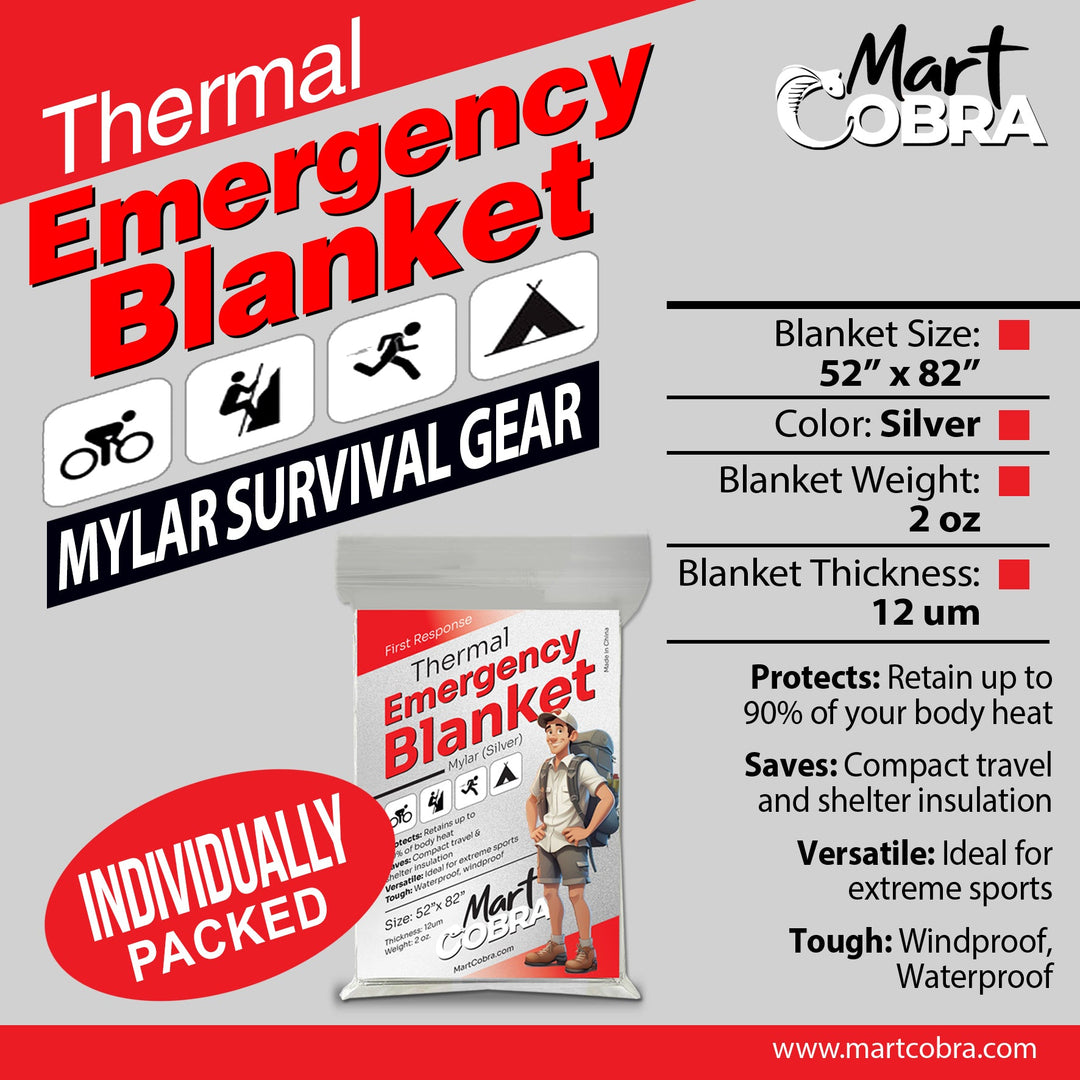
For a conventional silver-on-both-sidesMart Cobra Mylar Emergency Blanket, either reflective face can generally be positioned toward the body.
You do not need to spend time identifying a special warming side.
Mart Cobra's emergency blanket measures82 × 52 inches when unfolded and is designed to fold into a compact package for emergency preparedness.
Its lightweight reflective construction makes it practical to store in:
-
Vehicle emergency kits
-
Hiking backpacks and go bags
-
Household preparedness supplies
-
Camping and travel equipment
For warmth, the most important considerations remain proper wrapping, dry clothing, wind protection, and insulation.
If you want enclosed coverage rather than a flat sheet,Mart Cobra Emergency Sleeping Bags provide another compact emergency option.
An emergency sleeping bag can help maintain coverage around one person, although additional insulation and shelter remain important in cold conditions.
For help deciding which design belongs in your kit, readWhat Are the Best Emergency Blankets for Survival?.
Common Myths About Emergency Blanket Orientation
Myth 1: The Silver Side Must Always Face Your Body
Reality: There is no universal rule requiring the silver side to face inward on every emergency blanket.
For a standard double-silver design, either side can generally be used.
Myth 2: The Gold Side Is for Warming and the Silver Side Is for Cooling
Reality: Color alone does not establish separate heating and cooling functions.
Different manufacturers may use different materials and coatings, but reversing an ordinary emergency blanket does not create an automatic temperature-control mode.
Myth 3: The Shinier Side Always Keeps You Much Warmer
Reality: Visible shininess is not a reliable measure of real-world protection against heat loss.
Actual performance depends on the reflective coating, moisture, surrounding insulation, and how the blanket is used.
Myth 4: Mylar Works Like an Insulated Sleeping Bag
Reality: Thin reflective film does not contain the thick, air-trapping insulation found in conventional sleeping bags.
It can help reduce some forms of heat loss, but it is not a complete cold-weather sleep system.
Myth 5: Choosing the Correct Side Is the Most Important Part
Reality: In an emergency, controlling wind exposure, staying dry, using insulating layers, and obtaining shelter are much more important.
Frequently Asked Questions
Does the Shiny Side of an Emergency Blanket Go In or Out?
For a typical double-silver Mylar emergency blanket, either side can face inward. For products with different coatings or manufacturer-specific instructions, follow those directions.
Does the Gold Side of an Emergency Blanket Keep You Warmer?
Not necessarily. Research reviewing gold-and-silver reflective foils found that the outward-facing color is not a decisive factor for hypothermia protection in wilderness emergencies.
Can You Use Both Sides of a Mylar Blanket?
Generally, yes, for ordinary double-silver emergency blankets. If your blanket has different coatings or a specialized design, consult its instructions.
Should an Emergency Blanket Touch Bare Skin?
It is generally more practical to wrap an emergency blanket over dry clothing. Clothing provides insulation that the thin reflective film does not.
Can a Mylar Blanket Keep You Warm in Freezing Temperatures?
It can help reduce heat loss, but it cannot generate warmth or replace appropriate insulation and shelter. Freezing conditions require additional protective equipment.
Key Takeaways
-
For typical double-silver Mylar emergency blankets, either side can face your body.
-
Gold-and-silver blanket orientation is not the deciding factor in protection against heat loss.
-
Manufacturer instructions matter when a product has specialized or genuinely different surfaces.
-
Flipping a blanket does not automatically switch it between warming and cooling.
-
Mylar can help reduce radiant heat loss and act as a barrier against wind and moisture, but it provides very little conventional insulation.
-
Dry clothing, ground insulation, wind protection, and shelter are more important than blanket orientation.
The bottom line: If you're cold and have a standard Mylar emergency blanket, wrap yourself in it rather than worrying about which side faces inward. Focus on reducing drafts, staying dry, and getting appropriate insulation and shelter.
References
-
Kosiński et al. — Prehospital Use of Ultrathin Reflective Foils.Wilderness & Environmental Medicine, 2022. A scientific review of reflective foil heat-transfer mechanisms, practical limitations, and blanket orientation.
-
Centers for Disease Control and Prevention — Preventing Hypothermia. Guidance on hypothermia symptoms, cold exposure, dry clothing, and emergency warming measures.