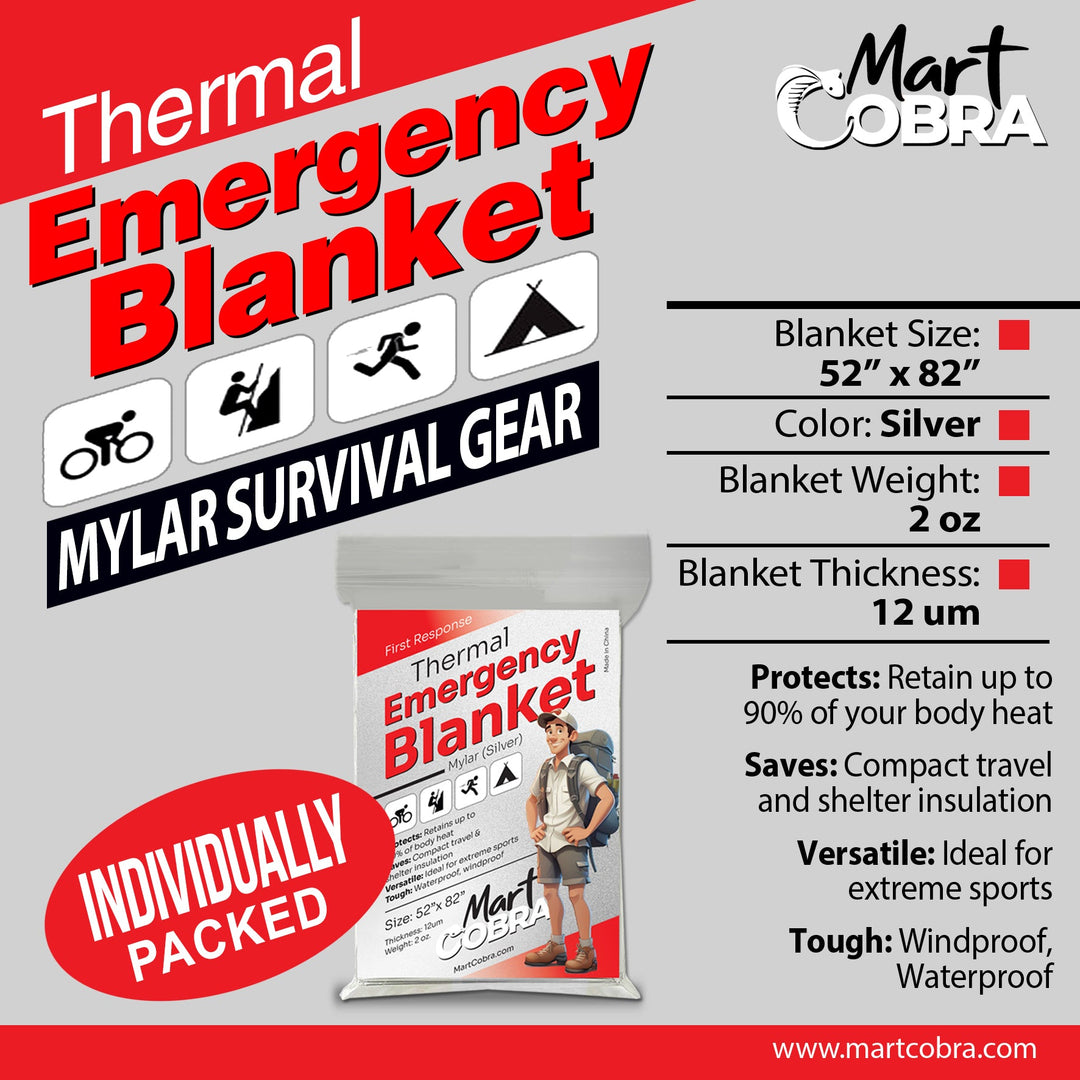
An emergency blanket is a flat sheet of thin, reflective material that is extremely compact and versatile. An emergency sleeping bag uses similar reflective material in an enclosed sack design that surrounds more of the body with fewer exposed edges.
Both are designed to provide lightweight emergency protection while taking up very little storage space. The biggest difference is how they cover the body: a blanket must be wrapped or draped around you, while an emergency sleeping bag provides enclosed coverage around the body.
Neither generates heat, and neither should be considered a replacement for appropriate clothing, insulation, shelter, or a temperature-rated sleeping bag when conditions require one.
How Do Emergency Blankets and Emergency Sleeping Bags Work?
Reflective emergency blankets are made from very thin material with a reflective metallic surface. Their purpose is to help reduce heat loss while providing a lightweight barrier between the user and the surrounding environment.
Reflective materials can help reduce radiant heat loss, while the thin plastic material can also reduce heat loss associated with wind and evaporation when used as a barrier. Research on reflective emergency foils also shows why they should not be treated like conventional insulation: they have very little insulating loft, and their performance can vary depending on wind, moisture, clothing, layering, coverage, and how the material is used.
That distinction matters.
A thick insulated sleeping bag works partly by trapping layers of relatively still air within insulating material. A thin emergency blanket or Mylar emergency sleeping bag does not provide that same type of insulation.
The advantage of reflective emergency gear is that it can provide useful coverage in an extremely lightweight, compact package.
What Is the Difference in Design and Coverage?

An emergency blanket is a flat reflective sheet with no enclosure.
When unfolded, it can provide full-body coverage, but it must be held, tucked, or wrapped around the body to stay in place. Because it is an open sheet, coverage depends partly on how the blanket is positioned and maintained.
An emergency sleeping bag uses an enclosed sack design, sometimes called a thermal bivy or emergency bivy. The body goes inside the sack while the head remains outside.
Because the sides and foot area are enclosed, the sleeping-bag format provides more complete body coverage with fewer exposed edges than a flat sheet.
The difference is primarily one of physical design and coverage. That does not mean an enclosed emergency sleeping bag is guaranteed to provide a specific thermal advantage in every environment.
Emergency Blanket vs. Emergency Sleeping Bag
| Feature | Emergency Blanket | Emergency Sleeping Bag |
|---|---|---|
| Design | Flat reflective sheet | Enclosed reflective sack |
| Body coverage | Depends on how it is wrapped or draped | More complete enclosed body coverage |
| Exposed edges | More exposed edges | Fewer exposed edges |
| Packed size | Extremely compact | Extremely compact, though size varies by product |
| Portability | Excellent | Excellent |
| Versatility | Can have uses beyond body coverage | Primarily designed for enclosed body coverage |
| Wind & moisture barrier | Material provides a barrier; overall protection depends on coverage and use | Material provides a barrier with fewer exposed edges |
| Car emergency kit | Excellent option | Excellent option |
| Go bag | Useful when minimal packed size and versatility matter | Useful when enclosed coverage is preferred |
Neither format is universally better. The more useful choice depends on where you're storing it, how much space you have, and what you want the item to do during an emergency.
How Do the Two Formats Compare on Packed Size, Portability, and Versatility?
One of the biggest advantages of a flat emergency blanket is how little space it can occupy.
A folded emergency blanket can fit into vehicle emergency kits, first-aid kits, backpacks, go bags, and other places where storage space is limited. Rescue blankets are recognized in medical literature in part for their very low weight and low bulk.
A flat sheet is also versatile.
Depending on the material, conditions, and situation, a reflective sheet can potentially serve as a temporary ground barrier, shade or shelter component, weather barrier, or reflective signaling aid in addition to covering the body.
An enclosed emergency sleeping bag is more specialized. Its primary advantage is its shape: rather than continuously holding or wrapping a flat sheet around yourself, you place your body inside the sack.
An enclosed bag typically uses more material than a single flat emergency blanket, so packed dimensions and weight can differ by product. Both formats, however, can still be extremely compact.
Which One Belongs in a Car Emergency Kit or Go Bag?
Either can make sense, and carrying both is also an option.
For a go bag where every inch of space and ounce of weight matters, a flat emergency blanket provides a lot of versatility in a very small package.
For a vehicle emergency kit, an enclosed emergency sleeping bag can be useful when you want more complete body coverage with fewer exposed edges.
The Mart Cobra Mylar Emergency Blanket measures 82" × 52" and folds smaller than a deck of cards, making it easy to keep in vehicle kits, backpacks, go bags, and other emergency-supply locations.
The Mart Cobra Emergency Sleeping Bag measures approximately 84" × 36" (7' × 3'), weighs under 5 oz., and packs smaller than a soda can.
Building out your vehicle supplies? See our car emergency kit checklist for the other food, water, first-aid, lighting, signaling, tools, and cold-weather gear worth considering.

When Should You Choose an Emergency Blanket?
A flat emergency blanket makes sense when minimum packed size, low weight, and versatility are priorities.
Its flat-sheet design makes it particularly useful for:
- Vehicle emergency kits
- First-aid kits
- Go bags
- Hiking or camping emergency supplies
- Backup emergency supplies stored in multiple locations
The advantage is that you're carrying a large reflective sheet in a very small package.
The tradeoff is coverage. Because a blanket is open on every side, it must be wrapped, tucked, or otherwise positioned around the body. Wind and movement can make maintaining that coverage more difficult.
If versatility and extremely compact storage are your priorities, see the Mart Cobra Mylar Emergency Blanket.
A flat emergency blanket should be considered an emergency tool rather than a substitute for appropriate clothing, insulation, or shelter.
When Does an Enclosed Emergency Sleeping Bag Make More Sense?
An emergency sleeping bag makes sense when you want more complete body coverage with fewer exposed edges.
Instead of wrapping a sheet around yourself, you place your body inside an enclosed sack with a closed foot and sides.
That can be useful in vehicle emergencies, power outages, or other situations where maintaining more complete body coverage with a flat sheet may be difficult.
The Mart Cobra Emergency Sleeping Bag uses this enclosed Mylar design while remaining compact enough for vehicle emergency kits, go bags, and other emergency supplies.
The head should always remain outside the emergency sleeping bag. The bag should not be placed over the face or used as an airtight enclosure.
Like a flat emergency blanket, an emergency Mylar sleeping bag does not replace appropriate clothing, conventional insulation, shelter, or a temperature-rated sleeping bag when conditions require them.
Can It Make Sense to Carry Both?
Yes.
The two formats serve overlapping but different purposes.
A flat emergency blanket gives you a multi-use reflective sheet that takes up very little room. An enclosed emergency sleeping bag gives you more complete body coverage with fewer exposed edges.
For example, someone might keep flat blankets in several backpacks or small emergency kits while keeping an enclosed sleeping bag in a vehicle kit.
You don't necessarily need both. The decision depends on available space, expected conditions, the number of people you're preparing for, and what you want your emergency gear to accomplish.
If your primary use is vehicle preparedness, our complete car emergency kit guide explains how these warmth supplies fit alongside first aid, water, food, lighting, tools, and roadside equipment.
Frequently Asked Questions About Emergency Blankets and Emergency Sleeping Bags
Do emergency blankets help reduce body heat loss?
Yes. Reflective emergency blankets can reduce heat loss through several mechanisms, including by reducing radiant heat transfer and acting as a barrier against wind and evaporation. Their effectiveness depends on factors including coverage, wind, moisture, clothing, layering, and how they are used.
Do emergency blankets generate heat?
No. An emergency blanket does not create heat.
Its purpose is to help reduce heat loss from heat your body is already producing. Reflective emergency material is also extremely thin and should not be confused with conventional lofted insulation.
Can you sleep while using an emergency blanket?
A flat emergency blanket can be used while resting, but because it is an open sheet, maintaining coverage depends on how it is wrapped and positioned.
An enclosed emergency sleeping bag provides more complete body coverage with fewer exposed edges.
Neither should be treated as a replacement for an appropriately temperature-rated sleeping bag when conditions require one.
Does an emergency sleeping bag provide more complete coverage?
Yes, by design.
An enclosed emergency sleeping bag has closed sides and a closed foot area, leaving fewer exposed edges around the body than a flat sheet.
That is a statement about physical coverage—not a guarantee of a specific temperature or thermal-performance advantage.
Is a Mylar emergency sleeping bag airtight?
No. It should never be treated or used as an airtight enclosure.
Keep your head completely outside the bag and never cover or enclose your face inside it.
What’s the biggest practical difference between the two?
The biggest differences are design, coverage, exposed edges, and versatility.
A flat emergency blanket provides a highly compact, multi-use sheet. An emergency sleeping bag provides enclosed body coverage with fewer exposed edges.
Does carrying both make sense?
It can.
A flat blanket gives you greater versatility, while an enclosed emergency sleeping bag provides a different form of body coverage. Whether you need one or both depends on your emergency plan and available storage space.
Key Takeaways
- An emergency blanket is a flat reflective sheet, while an emergency sleeping bag is an enclosed reflective sack.
- Both are lightweight emergency tools designed to reduce heat loss; neither generates heat.
- Reflective emergency material is extremely thin and does not provide the same insulating loft as conventional insulated clothing or sleeping bags.
- A flat blanket has more exposed edges but offers greater versatility.
- An enclosed emergency sleeping bag provides more complete body coverage with fewer exposed edges.
- Neither format replaces appropriate clothing, insulation, shelter, or a temperature-rated sleeping bag when conditions require one.
- A blanket, sleeping bag, or both can make sense depending on where the gear will be stored and how you expect to use it.