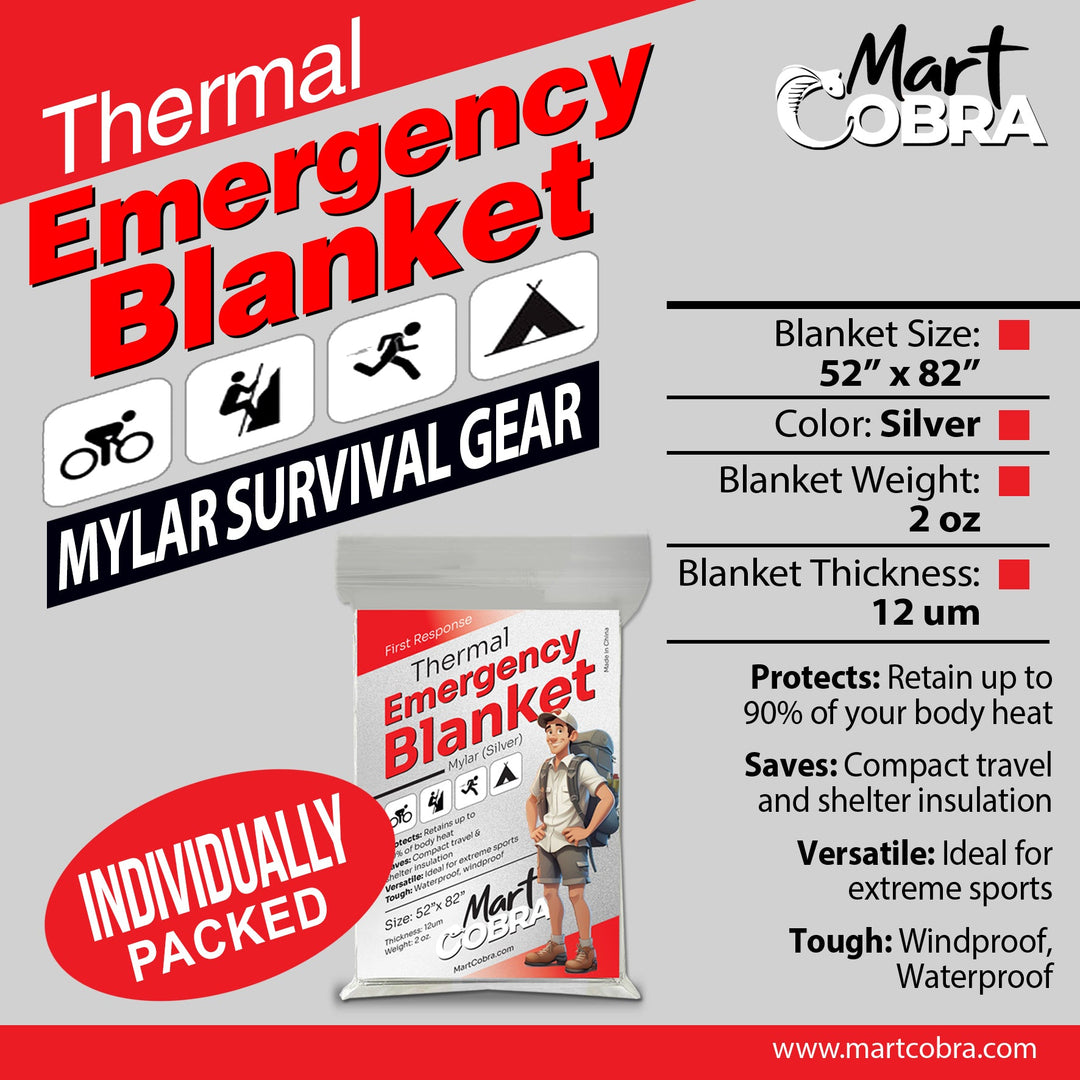
Do emergency blankets expire? Most Mylar emergency blankets do not have a universally established expiration date. Unlike food or medication, they don't necessarily become unusable after a fixed number of years. Instead, their condition, packaging, storage environment, and previous use help determine whether they're still suitable for an emergency.
An unused emergency blanket stored in its original packaging may remain usable for years. However, there is no universal shelf-life guarantee that applies to every brand, material thickness, or storage condition.
Here's how to determine whether your emergency blankets are still worth keeping, what can damage them, and how to store them properly.
Do Emergency Blankets Actually Expire?
There is no single expiration period that applies to every Mylar emergency blanket.
Conventional emergency blankets are typically made from a thin plastic film with a reflective metallic layer. Their primary functions are to help reduce radiant heat loss and provide a barrier against wind and external moisture.
Unlike food or batteries, an emergency blanket doesn't depend on perishable ingredients or stored electrical energy to perform its function.
However, that doesn't mean it will remain in perfect condition indefinitely.
Physical damage, deterioration of the film, and compromised packaging can affect its usefulness.
If your blanket includes a manufacturer-provided expiration or replacement date, follow that guidance.
The key distinction: An emergency blanket doesn't necessarily stop working on a particular date, but that doesn't mean every blanket can be stored indefinitely without inspection.
For more information about the material itself, read our guide toMylar blankets vs. space blankets.
How Long Do Emergency Blankets Last in Storage?
A properly stored, unused emergency blanket may remain usable for many years, but there is no established lifespan that applies to every Mylar blanket.
Three factors are particularly important.
1. Whether the Packaging Is Intact
Emergency blankets are commonly folded into compact packaging.
Keeping a blanket packaged helps protect it from accidental punctures, abrasion, dirt, and repeated handling.
However, packaging can also become damaged during shipping, transportation, or long-term storage.
An unopened blanket is generally preferable for emergency storage, but intact packaging alone doesn't guarantee the material inside is undamaged.
2. Where the Blanket Is Stored
A blanket kept in a cool, dry indoor location generally experiences more stable conditions than one stored in a vehicle or exposed outdoor equipment bag.
Sunlight, high temperatures, moisture, and other environmental conditions can affect certain plastic materials over time.
The extent of any deterioration depends on the specific film, coating, packaging, and exposure.
There is insufficient blanket-specific evidence to claim that every Mylar emergency blanket loses its reflective properties after a particular number of years in storage.
Nevertheless, protecting emergency supplies from unnecessary environmental exposure is a sensible precaution.
3. Whether the Blanket Has Been Used
An unopened emergency blanket and one that has been unfolded, wrapped around someone, and repacked repeatedly are not in the same condition.
Each use creates opportunities for physical damage.
An older, unopened blanket may therefore be in better condition than a newer blanket that has already experienced significant wear.
Age alone is not a reliable measure of an emergency blanket's condition.
What Causes Emergency Blankets to Wear Out?
Emergency blankets are lightweight and compact because their material is extremely thin.
That makes them convenient for survival kits, but it also means they require careful handling.
Tears and Punctures
Sharp objects, branches, rough surfaces, and excessive pulling can damage the film.
A small hole doesn't automatically eliminate all the blanket's reflective properties, but punctures and tears can compromise its ability to provide continuous wind and moisture protection.
Replace blankets with substantial or widespread damage.
Abrasion and Reflective Surface Damage
The reflective metallic surface plays an important role in reducing radiant heat transfer.
Scratching, rubbing, or other physical damage can affect that surface.
Extensive peeling, widespread coating damage, or separation between material layers are reasons to question a blanket's reliability.
However, appearance alone cannot precisely measure how much thermal performance remains.
Sunlight and Environmental Exposure
Extended exposure to ultraviolet light and unfavorable environmental conditions can affect certain plastic films.
The National Institute of Standards and Technology (NIST) has published research on how environmental exposure affects the durability of polymer materials.
However, these general findings should not be treated as a tested expiration schedule for emergency blankets.
The practical recommendation is to keep emergency blankets protected from unnecessary sunlight, moisture, and extreme storage conditions.
Repeated Handling
Unfolding, pulling, wrapping, and repacking a thin emergency blanket can create additional stress.
Normal wrinkles and creases are not automatically signs of failure.
The more important concern is whether the film has developed actual tears, punctures, or other significant damage.
If you frequently use emergency blankets outdoors, inspect them regularly rather than assuming they'll remain suitable for emergencies indefinitely.
How to Check Whether an Emergency Blanket Is Still Good
For an already opened emergency blanket, a basic visual inspection can help identify obvious problems.
Step 1: Check for Tears and Holes
Carefully unfold the blanket in a clean area with good lighting.
Look for visible tears, punctures, and damaged corners.
Holding sections toward a light source may help reveal small holes.
Step 2: Examine the Reflective Surface
Look for extensive scratches, peeling, flaking, or separation of the metallic coating.
These are reasons to question the blanket's condition.
Don't deliberately scrape or repeatedly stress the surface to test it, since doing so could create additional damage.
Step 3: Check for Contamination
If the blanket has been exposed to blood, bodily fluids, or other potentially hazardous contamination, replacement is generally the simplest practical choice for an inexpensive emergency blanket.
Step 4: Inspect the Packaging
For unopened blankets, check the packaging for punctures, moisture damage, or evidence of rough handling.
You don't necessarily need to open every sealed blanket for inspection.
Opening it exposes the material to additional handling and can make compact storage more difficult.
Step 5: Decide Whether Replacement Makes Sense
Ask yourself whether you'd be comfortable relying on the blanket during an emergency.
If the material is substantially damaged or its condition is uncertain, replacement is a reasonable precaution.
A visual inspection can identify obvious damage, but it cannot certify a blanket's remaining thermal performance.

When Should You Replace an Emergency Blanket?
There is no universal replacement schedule for all Mylar emergency blankets.
Instead, consider the condition of the material and any manufacturer guidance.
| Blanket condition | Recommended action |
|---|---|
| Unopened with intact packaging | Generally reasonable to keep if properly stored |
| Normal wrinkles or creases | Not automatically a reason to replace |
| Minor isolated puncture | Assess damage; replace if dependable weather protection is needed |
| Large tears or multiple holes | Replace |
| Extensive reflective surface damage | Replace |
| Moisture-damaged packaging | Inspect or replace |
| Hazardous contamination | Replace |
| Manufacturer replacement date reached | Follow manufacturer guidance |
Replacing an inexpensive blanket with questionable condition is generally preferable to relying on damaged equipment during an emergency.
However, there is no evidence-based reason to automatically discard every intact Mylar blanket after an arbitrary number of years.
How to Store Emergency Blankets Properly
Good storage practices help protect emergency blankets and keep them accessible.
Government emergency-preparedness guidance recommends periodically reviewing emergency supplies and maintaining emergency kits.
TheVirginia Department of Health recommends checking emergency supplies at least annually.
This is a general emergency-kit maintenance recommendation, not a scientifically established expiration interval for Mylar blankets.

Storing Emergency Blankets in Your Car
Vehicles are one of the most useful places to keep emergency blankets.
They can provide temporary protection if you become stranded, encounter severe weather, or need to wait for assistance.
To protect your blankets:
-
Keep them in their original packaging.
-
Place them inside a protected emergency-kit compartment.
-
Avoid leaving them exposed on dashboards or seats in direct sunlight.
-
Separate them from sharp tools and abrasive objects.
-
Review your emergency supplies periodically.
A blanket doesn't automatically become unusable after one summer in a vehicle.
However, because vehicles experience changing temperatures and storage conditions, periodic inspection is sensible.
For more vehicle preparedness advice, readWhat Should You Keep in a Car Emergency Kit?.
Storing Emergency Blankets in a Go Bag
Keep packaged emergency blankets in a protected compartment.
Avoid placing unpackaged blankets beside knives, metal tools, or other objects that could puncture the film.
Because they're compact, emergency blankets can be distributed among individual go bags rather than relying on a single shared blanket.
Storing Emergency Blankets at Home
Choose a dry, protected location away from direct sunlight.
A closet, emergency supply cabinet, or covered storage container is generally a practical choice.
Keep emergency supplies organized so family members can find them quickly.
For a broader checklist, seeWhat Should You Keep in a Family Emergency Kit?.
Do Emergency Blankets Last Longer If You Never Open Them?
Keeping an emergency blanket unopened reduces the amount of physical handling it experiences.
That can help protect the film from scratches, punctures, and other accidental damage.
However, unopened doesn't automatically mean undamaged.
Packaging can be compromised during transportation or storage, and environmental conditions can still affect materials over time.
The best approach is to combine protected storage with periodic checks of the packaging.
You don't need to open every emergency blanket simply to inspect it.
Instead, check for obvious packaging damage and follow any storage or replacement instructions provided by the manufacturer.
Can You Reuse an Emergency Blanket?
Some Mylar emergency blankets can be reused if they remain intact and suitable for their intended purpose.
However, thin emergency blankets are generally better suited to occasional emergency deployment than repeated everyday use.
There is no reliable universal rule that every standard emergency blanket lasts two or three uses or that every heavy-duty version lasts ten or more.
Actual durability depends on construction, thickness, handling, and conditions of use.
For a previously used blanket:
-
Check for tears, punctures, and significant surface damage.
-
Make sure it hasn't been contaminated.
-
Allow moisture to dry before repacking.
-
Protect the blanket from sharp objects during storage.
-
Replace it if its condition is questionable.
If an opened blanket no longer fits in its original package, a larger resealable bag can help protect it from dirt and physical damage.
Remember that emergency blankets are not substitutes for substantial insulation.
They can help reduce radiant heat loss and provide wind protection, but they don't provide the thick trapped-air insulation of conventional insulated bedding.
ReadHow Long Do Emergency Blankets Keep You Warm? for a more detailed explanation.
Should You Keep Extra Emergency Blankets?
Keeping additional emergency blankets can be practical because emergencies don't always happen in the same location.
You may need supplies at home, in a vehicle, or while traveling.
If several people need protection at once, a single compact blanket may not provide adequate coverage for everyone.
FEMA's emergency supply checklist recommends preparing emergency supplies for different locations and situations.
For households building or replenishing emergency supplies,Mart Cobra Mylar Emergency Blankets are available in multi-pack options.
The goal is to have usable supplies available when and where they're needed.
Frequently Asked Questions
Do emergency blankets expire after five years?
There is no universal five-year expiration rule for Mylar emergency blankets. Check any manufacturer guidance and evaluate the condition of the blanket and its packaging.
Can emergency blankets last ten years?
An unused blanket may remain usable for many years under suitable conditions, but ten years is not a guaranteed lifespan for every product.
Do Mylar blankets lose their reflective properties?
Reflective surfaces can be damaged by abrasion or other deterioration. However, there is no established universal rate at which all emergency blankets lose reflectivity during storage.
Can you leave emergency blankets in your car year-round?
Yes, emergency blankets are commonly included in vehicle emergency kits. Protect them from direct sunlight and physical damage, and inspect your supplies periodically.
Should you open a sealed emergency blanket to check it?
Not routinely. You can inspect the outside of the packaging first. If the package is damaged or the blanket's condition is questionable, consider replacement.
How often should you inspect emergency blankets?
Checking them as part of an annual emergency-kit review is a practical approach. This is a maintenance recommendation, not a scientifically established blanket expiration schedule.
Is an old emergency blanket better than nothing?
An older blanket that remains intact may still provide useful wind and moisture protection. However, damaged equipment should not be relied upon as your primary protection from dangerous cold or severe weather.
Final Thoughts: Do Emergency Blankets Really Expire?
Emergency blankets don't have a universal expiration date, but their condition still matters.
An unused, properly stored Mylar blanket may remain suitable for years. Physical damage, poor storage, and repeated handling are reasons to inspect or replace one.
Rather than automatically discarding every blanket after a fixed period, review your emergency supplies regularly and replace items that are no longer dependable.
For instructions on using a blanket effectively, see ourstep-by-step emergency blanket guide.
References
-
Virginia Department of Health — Preparing Your Emergency Supply Kit — Government guidance on emergency supplies, kit maintenance, and periodic inspection.
-
FEMA / Ready.gov — Emergency Supply List — Federal emergency-preparedness checklist for household and portable emergency supplies.
-
U.S. Army — Ready Army — Government emergency-preparedness information, including kit planning and maintenance.
-
National Institute of Standards and Technology — Polymeric Materials — Independent technical background on polymer materials and their properties; not a Mylar emergency blanket shelf-life study.
Note: No universal emergency blanket shelf-life figure is established by these references. The inspection and replacement recommendations above are practical preparedness guidance, not manufacturer-certified performance testing.