The best emergency blanket for survival depends on how you plan to use it. For everyday emergency preparedness, a lightweight Mylar blanket is often the most practical choice because it is compact, affordable, and easy to store. For repeated outdoor use, a reinforced reflective blanket may be more suitable. When keeping a person covered in wind or cold is the priority, an enclosed emergency sleeping bag or bivy can be easier to use than a flat sheet.
There is no single emergency blanket that is best for every situation. The right choice depends on portability, durability, coverage, weather conditions, and the other supplies available.
Emergency blankets can help reduce heat loss, but they do not generate heat or replace warm clothing, shelter, or insulation from cold ground.

What Are the Best Types of Emergency Blankets for Survival?
Most reflective emergency blankets fall into three categories: standard Mylar blankets, reinforced reflective blankets, and enclosed emergency sleeping bags or bivies.
Each offers different advantages.
| Type | Best for | Main advantage | Main limitation |
|---|---|---|---|
| Lightweight Mylar blanket | Go bags, vehicle kits, home preparedness, hiking backups | Extremely compact and versatile | Thin material can tear or puncture |
| Reinforced reflective blanket | Camping, repeated outdoor use, improvised windbreaks | More resistant to rough handling when properly constructed | Heavier and bulkier |
| Emergency sleeping bag or bivy | Cold-weather backup, roadside emergencies, unexpected overnight exposure | Enclosed coverage that is easier to maintain in wind | Less versatile than a flat blanket and provides limited insulation |
These are general differences between designs, not the results of standardized comparative testing. Actual performance depends on the product's materials, construction, dimensions, and how it is used.
1. Lightweight Mylar Emergency Blankets: Best for Everyday Preparedness
For most people building an emergency kit, a standard Mylar emergency blanket is an excellent starting point.
These blankets use a thin, metallized plastic film that folds into a small package. Their reflective surface helps reduce radiant heat loss, while the material can also provide a barrier against wind and moisture.
Their biggest advantage is convenience. A blanket that fits into a glove compartment, backpack, or small emergency kit is easier to keep available than bulky equipment that gets left behind.
Lightweight Mylar blankets are particularly useful for:
-
Vehicle emergency kits and roadside breakdowns
-
Hiking backpacks and go bags
-
Household emergency supplies
-
Travel and unexpected weather changes
-
Providing a compact backup layer for multiple people
A flat blanket can also be used as an improvised wind barrier, reflective signaling surface, or temporary ground cover. However, a thin sheet is not a substitute for a durable tarp, insulated sleeping pad, or proper shelter.
The main drawback is durability. Standard Mylar can tear around sharp objects, puncture under rough handling, or become damaged when repeatedly folded and unfolded.
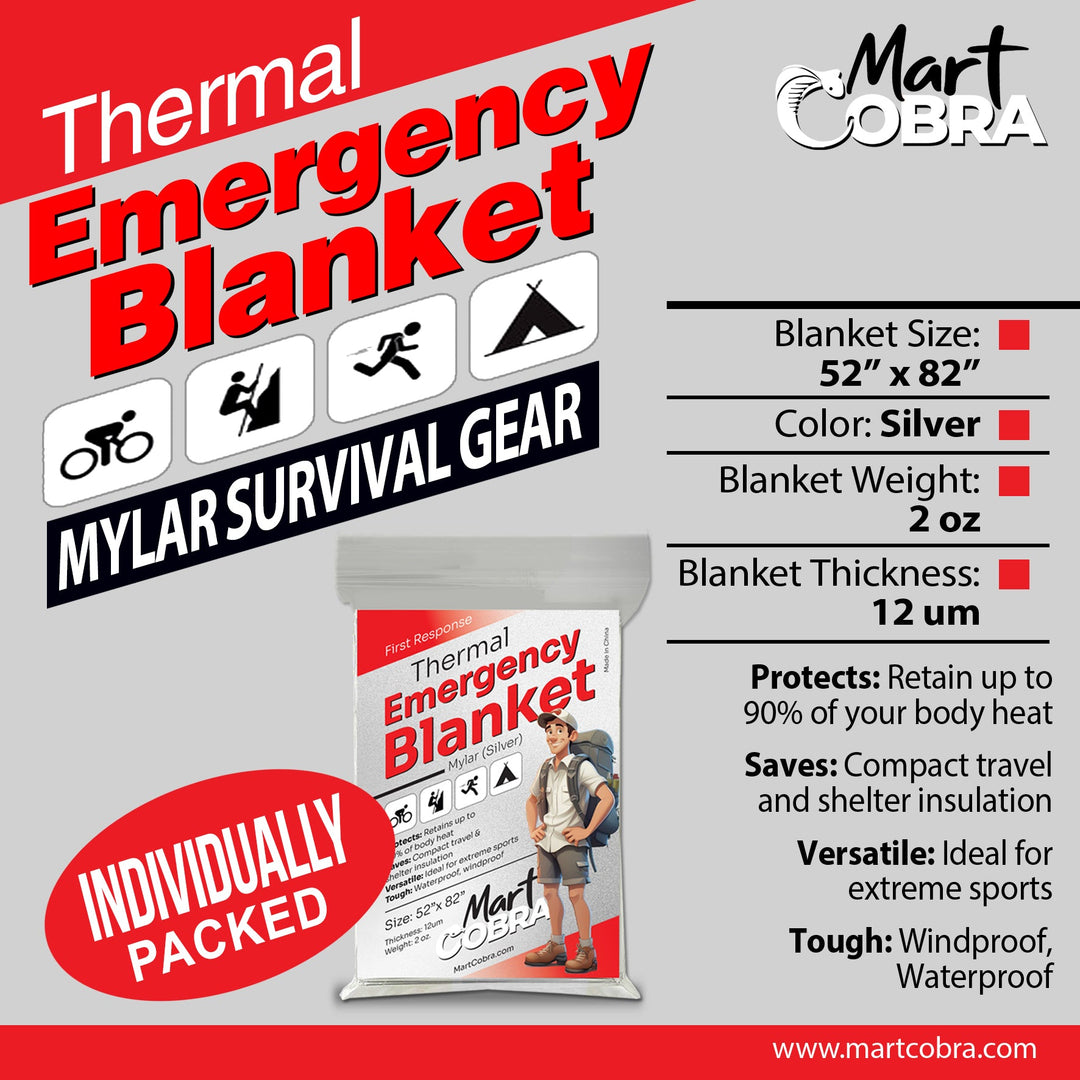
For an example of this category,Mart Cobra Mylar Emergency Blankets measure 82 × 52 inches when opened and fold into a compact package suitable for vehicle kits, backpacks, and household preparedness.
Best choice when: You want lightweight emergency coverage that can be stored in multiple locations without taking up much space.
2. Reinforced Reflective Blankets: Best for Durability and Repeated Use
Reinforced reflective blankets are designed for situations where a thin emergency sheet may not be durable enough.
Instead of relying solely on a lightweight metallized film, these products may combine a reflective surface with woven or laminated backing materials. Depending on their construction, they can offer greater resistance to tearing and punctures.
Some reinforced blankets also include finished edges or reinforced attachment points, making them useful for improvised windbreaks or temporary shelter applications.
They can be a practical choice for:
-
Camping and outdoor activities involving repeated setup
-
Emergency gear that may be handled frequently
-
Situations where a blanket could contact rough surfaces
-
Temporary windbreaks or protective ground barriers
However, reinforced does not automatically mean warmer.
A heavier backing may improve physical durability without providing substantial thermal insulation. Reflective performance, wind protection, and resistance to conductive heat loss are separate characteristics.
Reinforced blankets also tend to occupy more storage space than standard thin Mylar blankets.
When shopping, examine the backing material, seams, edge construction, packed dimensions, and whether any tie-down points are actually reinforced. Do not assume that every product labeledheavy-duty offers the same level of durability.
Best choice when: Repeated handling and resistance to damage matter more than minimum packed size.
For a more detailed explanation, see our guide towhich emergency thermal blankets are most durable for cold weather.
3. Emergency Sleeping Bags and Bivies: Best for Enclosed Emergency Coverage
An emergency sleeping bag, sometimes called an emergency bivy, uses a different design from a flat survival blanket.
Instead of wrapping a rectangular sheet around the body, the user gets inside an enclosed bag. This makes it easier to keep the reflective material positioned around the body, particularly when resting or dealing with wind.
An enclosed design can also reduce gaps where moving air enters, although effectiveness depends on the bag's construction and how it is used.
Emergency sleeping bags are useful for:
-
Unexpected overnight delays outdoors
-
Roadside emergencies in cold weather
-
Hiking or camping backup equipment
-
Emergency kits where an enclosed covering is desirable
-
Situations where a flat blanket may be difficult to keep wrapped
For example, theMart Cobra Emergency Sleeping Bag measures 84 × 36 inches and uses reflective Mylar in a compact, enclosed design.
It is important to distinguish this type of emergency bag from an insulated camping sleeping bag.
A thin reflective bivy can help limit radiant heat loss and reduce exposure to moving air, but it does not provide the thick insulating fill found in a conventional sleeping bag. It should not be treated as a complete cold-weather sleep system.
Best choice when: Keeping reflective material around one person is more important than the flexibility of an open blanket.
For a fuller comparison, readEmergency Blanket vs. Emergency Sleeping Bag: Which Should You Choose?.
Do Emergency Blankets Actually Work?
Yes. Reflective emergency blankets can help reduce heat loss, particularly by limiting radiant heat transfer and providing a barrier against wind.
The important distinction is that theyreduce heat loss rather than produce heat.
A person loses heat through several processes:
-
Radiation: Heat emitted from the body toward cooler surroundings.
-
Convection: Heat carried away by moving air.
-
Conduction: Heat transferred through direct contact with colder surfaces.
-
Evaporation: Heat lost as moisture evaporates from skin or clothing.
Reflective Mylar primarily addresses radiant heat transfer. When properly positioned, its thin film can also help block wind and moisture.
However, Mylar provides little loft or cushioning. If someone is sitting or lying on frozen ground, the blanket alone does not provide meaningful insulation against conductive heat loss.
This is why emergency blankets work best alongside dry clothing, insulating layers, protection from wind, and something insulating beneath the body.
TheCenters for Disease Control and Prevention emphasizes moving a person with suspected hypothermia into shelter, removing wet clothing, and using dry layers to help warm them.
A reflective emergency blanket can be one component of that protection, but it should never be the only measure relied upon in dangerously cold conditions.
How Do You Choose the Best Emergency Blanket for Your Situation?
Rather than choosing a blanket based on a single ranking, start with where you will store it and what you might need it to do.
Best Emergency Blanket for a Go Bag
For a go bag or compact survival kit,a lightweight Mylar blanket is generally the most practical option.
It takes up very little room, allowing space for water, first-aid supplies, a flashlight, food, clothing, and other essentials.
A flat blanket also offers flexibility. It can be wrapped around the body or used as an improvised barrier, depending on the situation.
If your go bag is intended for travel through cold or remote areas, consider adding an emergency bivy or more substantial insulation rather than relying on a single reflective sheet.
Best Emergency Blanket for a Car Emergency Kit
For a vehicle kit, a combination of supplies is usually better than choosing only one blanket.
Lightweight Mylar blankets are convenient because they can be stored for multiple passengers without occupying much space.
An enclosed emergency sleeping bag may be useful as an additional backup for someone waiting in a cold vehicle.
However, in freezing weather, neither should replace warm clothing or substantial blankets.
TheNational Weather Service recommends carrying extra blankets or sleeping bags, warm clothing, food, water, and other winter survival supplies in vehicles.
For a complete list of essentials, seeWhat Should You Keep in a Car Emergency Kit?.
Best Emergency Blanket for Hiking
For day hiking, a compact Mylar blanket is a useful backup because it adds little weight or bulk.
If a hike becomes longer than planned, the blanket may help reduce exposure while waiting for assistance.
For remote hiking, cold-weather routes, or trips where an unexpected overnight stay is possible, an enclosed emergency bivy may be worth the additional space.
Neither replaces appropriate clothing, navigation equipment, shelter, or the supplies required for the expected conditions.
Best Emergency Blanket for Camping
For camping, the best choice depends on whether the blanket is intended as an emergency backup or for repeated outdoor use.
A standard Mylar blanket works well as a compact reserve item.
A reinforced reflective blanket may be more appropriate when the material will be handled frequently, placed near rough surfaces, or used as a temporary wind barrier.
For sleeping, a properly rated sleeping bag and insulated sleeping pad remain the primary equipment. A reflective emergency blanket or bivy should be considered supplemental protection rather than a replacement.
Best Emergency Blanket for a Home Emergency Kit
For household preparedness, storage space is usually less restrictive than in a backpack.
This makes it practical to keep emergency blankets available for multiple household members while also storing conventional warm blankets, extra clothing, and other supplies.
TheReady.gov emergency supply checklist recommends a sleeping bag or warm blanket for each person, with additional bedding in colder climates.
Lightweight reflective blankets can complement these supplies, particularly because they are easy to distribute among vehicles, bags, and other locations.
Ourfamily emergency kit guide explains how to build a more complete household preparedness setup.
What Should You Look for When Buying a Mylar Emergency Blanket?
Not every emergency blanket is equally suitable for every situation. Before buying, compare these practical features.

Size and Coverage
An emergency blanket should provide enough material to wrap around the intended user.
Check the unfolded dimensions rather than judging coverage from a folded product photograph.
A blanket that is too small may leave large gaps, particularly around the legs or shoulders.
For families, consider the needs of adults and children separately.
Packed Size and Weight
Portability matters most for hiking, go bags, and travel kits.
Thin Mylar blankets generally offer the smallest packed size. Reinforced blankets and enclosed bivies vary more widely in bulk and weight.
Check actual product specifications rather than assuming all blankets in a category are identical.
Tear Resistance and Construction
Thin reflective film can be damaged by sharp edges, abrasive surfaces, and rough handling.
If durability is important, look for reinforced backing, finished edges, and clear construction details.
A product's thickness alone does not establish how much force it can withstand. Reliable tear-resistance comparisons require appropriate testing.
Weather Protection
The material in many Mylar blankets resists wind and liquid water, but the effectiveness of the overall covering depends on how it is positioned.
An open blanket may allow drafts or rain to enter around its edges. An enclosed bag can reduce some of these openings, although seams, openings, and damage still matter.
Neither design should be assumed to replace a complete shelter system.
Intended Use
A flat emergency blanket offers greater flexibility for wrapping, covering equipment, creating shade, or improvising a barrier.
An enclosed emergency sleeping bag is more specialized for covering one person.
Choose based on the job you expect the product to perform.
Quantity and Storage Locations
A single emergency blanket stored at home cannot help during a roadside breakdown or hiking emergency.
Consider where people in your household spend time and where they might need supplies unexpectedly.
Keeping compact blankets in several locations can be more practical than storing every blanket in one large kit.
Are More Expensive Emergency Blankets Better?
Not necessarily.
Price alone does not establish thermal performance, durability, or suitability for survival use.
A higher-priced reinforced blanket may offer stronger construction and better repeated-use potential, but that does not automatically make it the best choice for a lightweight go bag.
Likewise, an enclosed emergency bivy may be more convenient for maintaining coverage around one person without offering the insulation of a conventional sleeping bag.
For many households, several compact Mylar blankets stored in useful locations may provide more practical preparedness value than a single bulky specialty blanket.
The better purchasing decision is the one that matches your expected conditions, storage requirements, and emergency plan.
How Should You Store and Use Emergency Blankets?
Emergency blankets are most useful when they are accessible, intact, and used correctly.
Store unopened blankets in a clean, dry location away from sharp objects and unnecessary exposure to heat or sunlight. Inspect emergency kits periodically for damaged packaging or material deterioration.
When using a reflective blanket for warmth:
-
Move out of wind, rain, or snow whenever possible.
-
Replace wet clothing with dry layers if available.
-
Wrap the blanket around the body to reduce gaps and drafts.
-
Keep the face unobstructed and maintain adequate ventilation.
-
Use an insulating pad, clothing, or other suitable material between the body and cold ground.
-
Seek proper shelter and assistance when conditions are dangerous.
For a detailed walkthrough, readHow to Use an Emergency Blanket: A Step-by-Step Guide.
Important: Hypothermia is a medical emergency. Warning signs can include confusion, slurred speech, unusual drowsiness, and loss of coordination. Seek emergency medical assistance when hypothermia is suspected. An emergency blanket is not a substitute for medical care.
Frequently Asked Questions About Survival Emergency Blankets
What is the best emergency blanket for survival?
For general emergency preparedness, a lightweight Mylar blanket is often the best starting point because it is compact, versatile, and easy to store. Reinforced reflective blankets are better suited to repeated rough handling, while enclosed emergency bivies can be more convenient for maintaining coverage around one person.
Are Mylar blankets better than regular blankets?
They serve different purposes. Mylar blankets are lightweight, reflective, and useful as wind and moisture barriers. Conventional blankets can provide more insulation by trapping air within their fibers. In cold conditions, using appropriate insulating layers alongside a reflective barrier may be more useful than choosing one or the other.
What is the difference between a space blanket and a Mylar blanket?
The terms are often used interchangeably.Space blanket is a common name for a thin reflective emergency blanket, whileMylar refers to a type of polyester film commonly associated with these products. For more detail, seeMylar Blanket vs. Space Blanket.
Can emergency blankets keep you warm in freezing temperatures?
They can help reduce heat loss, but they do not generate heat or provide the insulation needed for prolonged exposure to freezing conditions. Warm clothing, ground insulation, shelter, and other protective equipment remain essential.
Are emergency blankets reusable?
Some can be reused if they remain intact. However, thin Mylar can develop tears, punctures, or other damage during use. Inspect the material before relying on it again, and replace damaged blankets.
Should you choose an emergency blanket or an emergency sleeping bag?
Choose a flat blanket when versatility, portability, and coverage across different tasks matter most. Choose an emergency sleeping bag or bivy when keeping reflective material around one person is the priority. Some emergency kits benefit from including both.
Final Verdict: Which Emergency Blanket Should You Choose?
For most households and general survival kits, lightweight Mylar emergency blankets are the most versatile starting point. They are compact enough to keep in vehicles, backpacks, home emergency supplies, and travel bags.
If you expect repeated outdoor use or rough handling, a reinforced reflective blanket may be worth the additional bulk.
If your priority is enclosing one person during a cold-weather emergency, consider adding an emergency sleeping bag or bivy.
The strongest preparedness plan does not depend on one blanket alone. It combines appropriate reflective protection with warm clothing, insulation, shelter, and supplies matched to the conditions you might face.
Most importantly, choose emergency equipment you can realistically keep available before you need it.