The most durable emergency thermal blanket for cold weather depends on what you need it to do.
For repeated outdoor use, a heavier reinforced or backed thermal blanket will generally be more durable than a thin Mylar emergency blanket. For an emergency kit, however, durability is only one consideration. Thin Mylar blankets trade heavy-duty construction for extremely compact storage, low weight, and the ability to keep multiple blankets in different locations.
The important distinction is that durability and cold-weather performance are not the same thing. A blanket can be physically tough without providing much insulation, while a lightweight reflective blanket can still be useful as part of a layered cold-weather system.
So instead of looking for one "most durable" blanket for every situation, it makes more sense to choose the construction that fits how you'll actually use it.
What Does “Durable” Mean for an Emergency Thermal Blanket?
For an emergency blanket, durability generally comes down to a few practical questions:
- How easily can the material tear or puncture?
- Can it tolerate repeated unfolding and handling?
- Is it designed for one emergency or repeated outdoor use?
- Can it handle wind and moisture?
- How much space and weight does that added durability require?
A basic Mylar emergency blanket is an ultrathin reflective film. Its biggest advantages are weight and packed size rather than abrasion resistance.
A review published inWilderness & Environmental Medicine notes that ultrathin reflective foils have limited insulating ability on their own and cites field research in which these foils tore relatively easily. The same review emphasizes that traditional insulation works primarily by trapping air and that reflective foils can be particularly useful as an outer weather-resistant layer in cold and windy conditions.
That distinction matters:
Thin Mylar: prioritizes compactness and emergency availability.
Reinforced reflective blanket: prioritizes physical durability and repeated handling.
Insulated or fleece-backed blanket: prioritizes reusable construction and conventional insulation but requires considerably more storage space.
None is automatically the best choice for every emergency.

Are Thicker Emergency Blankets More Durable?
Generally, additional material, reinforcement, or backing can make an emergency blanket better suited to repeated handling than an ultrathin reflective film.
But thickness alone doesn't tell you everything.
Construction matters too. A reflective material laminated to a stronger backing is fundamentally different from a thin sheet of metallized film. Reinforced edges, woven layers, and heavier backing materials can all change how a blanket handles abrasion, pulling, and repeated use.
The tradeoff is straightforward: adding material generally means adding weight and packed volume.
That might be worthwhile for a blanket that will be regularly used at a campsite or stored permanently in a vehicle with plenty of room.
It can be less desirable when you're trying to fit emergency supplies into a compact go bag, first-aid kit, or multiple locations around a household.
Is a Mylar Emergency Blanket Durable?
A standard Mylar emergency blanket is durable enough for its intended role as a lightweight emergency item, but it shouldn't be confused with a heavy reusable camping blanket or tarp.
The material is intentionally thin so that a full-size blanket can fold into a very small package.
That creates its greatest advantage and its greatest limitation.
You can store emergency blankets in places where a bulky insulated blanket would be impractical, but the thin material also requires more care around sharp objects, rough surfaces, and strong pulling.
If a Mylar blanket has been used, inspect it before returning it to your emergency kit. Significant tears, punctures, or other damage are good reasons to replace it rather than assume it will perform the same way during the next emergency.
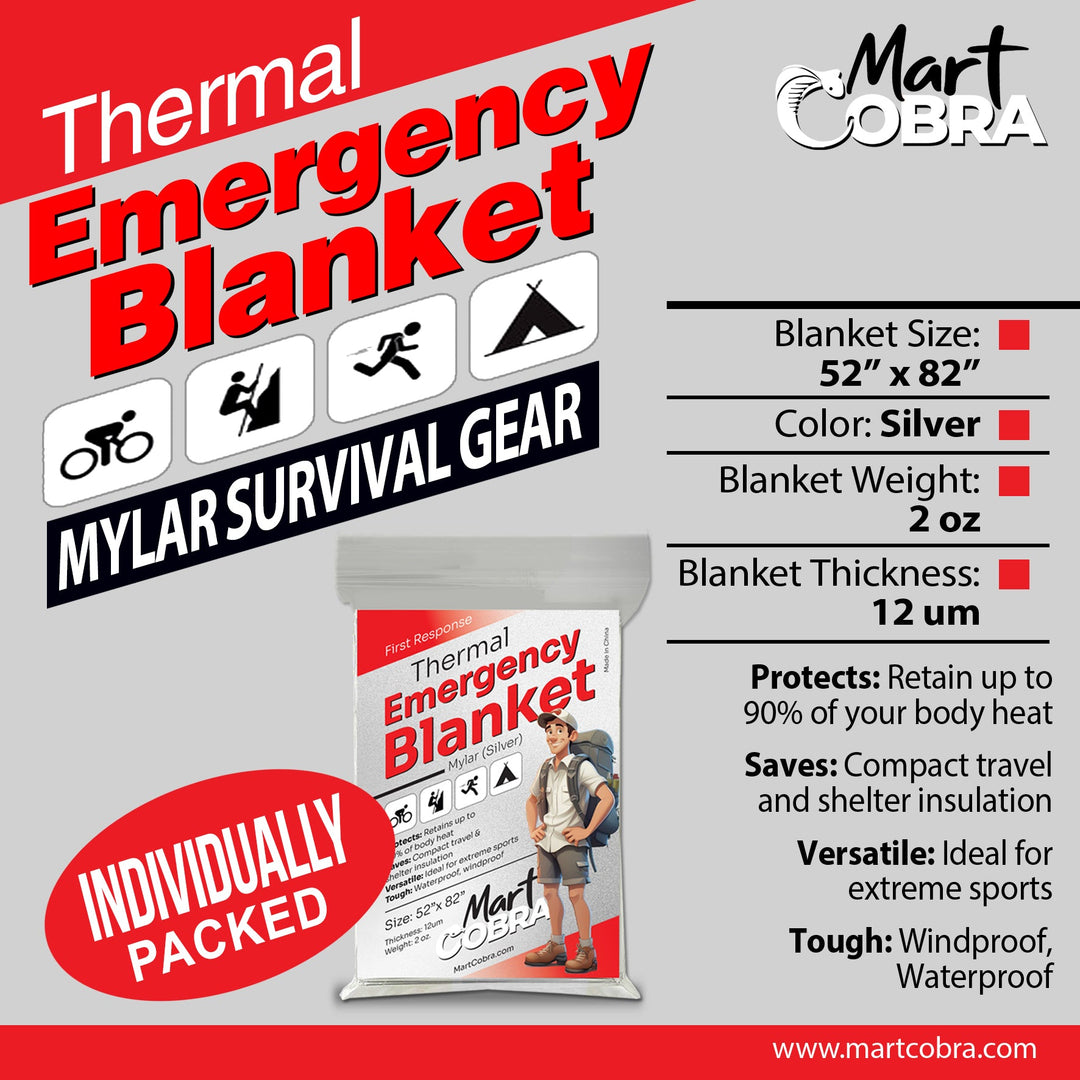
TheMart Cobra Mylar Emergency Blanket is designed around this compact-emergency role: a lightweight reflective blanket that can be stored in vehicles, home emergency supplies, backpacks, and go bags.
Does a More Durable Blanket Keep You Warmer?
Not necessarily.
This is probably the most important distinction when comparing emergency thermal blankets.
A physically stronger blanket does not automatically provide better thermal insulation.
Traditional insulation works largely by trapping layers of air. Ultrathin reflective foils contain almost no loft, so they should not be treated as equivalent to an insulated winter blanket or sleeping bag.
Research reviewing the use of ultrathin reflective foils found that in cold and windy conditions, these materials may be particularly useful as a waterproof outer covering over other insulation.
That's why cold-weather preparedness should be thought of as a system:
Insulating clothing + protection from wind and moisture + ground insulation + shelter + emergency supplies
rather than relying on one blanket to solve every problem.
For a deeper explanation, seeHow Long Do Emergency Blankets Keep You Warm?.
Which Type of Emergency Thermal Blanket Is Most Durable?
If physical durability alone is the priority, the general order is:
Insulated or Fleece-Backed Blankets
These are closest to conventional reusable blankets. Their thicker construction makes them more appropriate for repeated use, but they're also substantially bulkier and heavier.
They're best suited to situations where storage space isn't a major concern.
Reinforced or Laminated Reflective Blankets
These occupy the middle ground.
A stronger backing can make a reflective blanket more suitable for repeated outdoor handling than ultrathin Mylar while still retaining some of the weather-resistant characteristics associated with reflective emergency materials.
Again, the penalty is greater packed size and weight.
Thin Mylar Emergency Blankets
These prioritize portability rather than maximum tear resistance.
They are the easiest type to distribute throughout multiple emergency kits because they take up very little room.
That's particularly useful when the question isn't simply:
“Which blanket can survive the most abuse?”
but instead:
“Which blanket am I actually likely to have with me when something goes wrong?”

What Is the Best Emergency Blanket for a Car?
For a car emergency kit, there are two reasonable strategies.
If you have plenty of trunk space and want something designed for frequent reuse, you can keep a heavier blanket in the vehicle.
But compact Mylar blankets have an important advantage: you can store several without consuming much space.
That matters when more than one person may be in the vehicle.
The American Red Cross includes both an emergency Mylar blanket and an emergency Mylar sleeping bag in one of its winter automobile survival kits, alongside gloves, hand warmers, food, water, and other supplies.
That illustrates an important preparedness principle: an emergency blanket is one component of a larger cold-weather kit, not the entire solution.
If you're building one from scratch, seeWhat Should You Keep in a Car Emergency Kit?.
What Is the Best Emergency Blanket for a Go Bag?
A go bag changes the equation because every ounce and every inch of space matters.
A thick reusable blanket may be more physically durable, but it also consumes space that could otherwise hold water, food, first aid, medications, lighting, backup power, or other essential supplies.
That's where ultrathin Mylar makes particularly good sense.
You sacrifice some physical durability in exchange for:
- Very small packed size
- Low weight
- Full-body coverage when unfolded
- Wind and moisture protection
- Easy placement in multiple kits
If you're preparing supplies for an entire household, seeWhat Should You Keep in a Family Emergency Kit?.
What Is Best for Camping or Repeated Outdoor Use?
This is where a more substantial reusable blanket can make more sense than choosing ultrathin Mylar as your primary blanket.
If you know you're going to unfold the blanket repeatedly, expose it to rough surfaces, and pack it again and again, additional reinforcement can be worthwhile.
A conventional insulated blanket may also make more sense when warmth and comfort are priorities and carrying space isn't severely limited.
A Mylar emergency blanket can still be useful as a lightweight backup emergency layer, but that's a different job from being your everyday camping blanket.
That's an important distinction:
Emergency equipment doesn't always need to be the equipment you'd voluntarily use every day.
Sometimes its greatest advantage is simply that it is small enough to always be there.
Is an Emergency Sleeping Bag More Durable Than an Emergency Blanket?
Not automatically.
An emergency sleeping bag and an emergency blanket can be made from similar thin reflective materials. The biggest difference is their shape, not necessarily their material durability.
A blanket is a flat sheet that you wrap around yourself.
An emergency sleeping bag uses an enclosed sack design, which reduces the number of open edges you have to manage when resting or staying stationary.
If you're deciding between the two formats, readEmergency Blanket vs. Emergency Sleeping Bag: What's the Difference?.
You can also see theMart Cobra Emergency Sleeping Bag.
What Should You Check Before Relying on an Emergency Blanket?
Whatever construction you choose, inspect emergency equipment periodically.
Check for:
- Tears or punctures
- Damaged seams on reinforced designs
- Separation between layers on laminated blankets
- Damage caused by improper storage
- Missing or damaged packaging
- Moisture or contamination
- Enough blankets for the number of people you're preparing for
For Mylar blankets in particular, keeping an unopened backup can make more sense than repeatedly unfolding the emergency copy just to inspect it.
And remember that an emergency blanket shouldn't be your entire cold-weather plan.
Appropriate clothing, shelter, insulation from cold surfaces, and other emergency supplies remain important.
Which Emergency Thermal Blanket Is Most Durable for the Money?
There isn't one answer because value depends on the job.
If you want a blanket for repeated camping use, spending more on a reinforced or insulated reusable blanket can make sense.
If you're building emergency kits, however, the equation changes.
A compact Mylar blanket lets you put emergency coverage in:
- Multiple vehicles
- Home emergency kits
- Go bags
- Hiking packs
- RVs
- Workplace emergency supplies
Instead of judging value only by how many times one blanket can be reused, consider how many people and locations you need to prepare.
That's where lightweight Mylar emergency blankets make the most sense.
TheMart Cobra Mylar Emergency Blanket is intended for exactly this role: compact emergency preparedness rather than replacing a thick everyday blanket.
So, Which Emergency Thermal Blanket Is Most Durable for Cold Weather?
If maximum physical durability is your only priority, a heavy insulated or reinforced blanket generally makes more sense than ultrathin Mylar.
But that doesn't make it the best emergency blanket for every situation.
For repeated outdoor use, prioritize stronger construction and reusability.
For a vehicle with plenty of storage space, you can carry a heavier blanket—and still keep compact emergency blankets as backups.
For go bags, family emergency kits, and situations where size, weight, and widespread placement matter, thin Mylar offers a different advantage: you can actually have it available where and when you need it.
And in serious cold, don't rely on any emergency blanket by itself. Combine it with appropriate clothing, insulation, protection from wind and moisture, and shelter.
If you're new to reflective blankets,Mylar Blanket vs. Space Blanket: Is There Actually a Difference? explains the terminology and construction.
Key Takeaways
- Reinforced and insulated blankets are generally more physically durable than ultrathin Mylar.
- More durability usually means more weight and packed volume.
- Physical durability and thermal insulation are not the same thing.
- Thin Mylar's main advantage is compact emergency availability rather than repeated heavy-duty use.
- For camping and frequent reuse, a heavier reusable blanket may be the better choice.
- For go bags, vehicles, and distributed emergency kits, compact Mylar blankets have significant practical advantages.
- Cold-weather preparedness should combine clothing, insulation, weather protection, shelter, and emergency supplies rather than relying on one blanket.
References
-
Kosiński S, Podsiadło P, Darocha T, et al.Prehospital Use of Ultrathin Reflective Foils.Wilderness & Environmental Medicine. 2022;33(1):134–139.
https://pubmed.ncbi.nlm.nih.gov/34998706/ -
American Red Cross.Automobile Survival Kit with Winter Supplies.
https://www.redcross.org/store/automobile-survival-kit-with-winter-supplies/54894.html