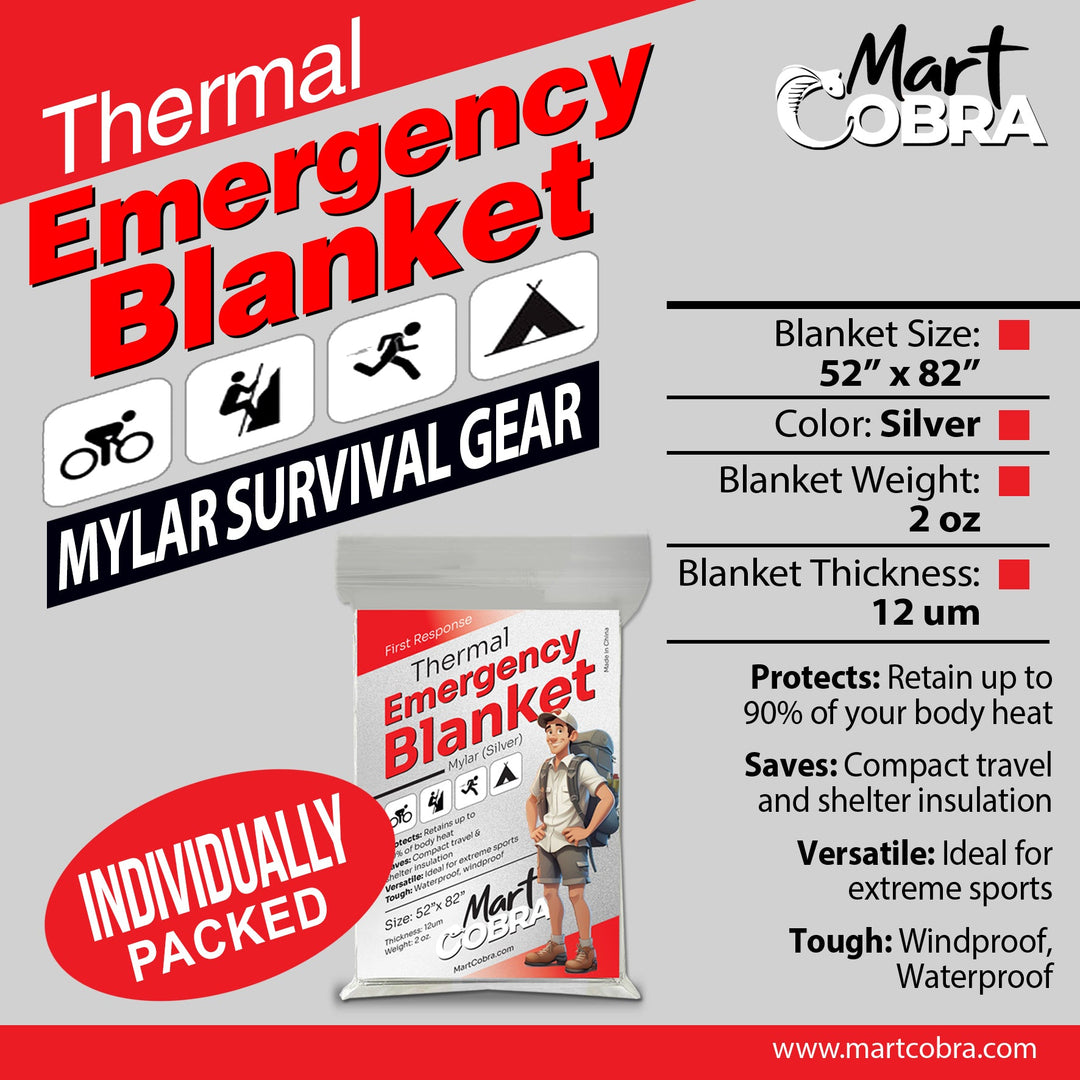
Yes, Mylar emergency blankets are waterproof at the material level. Their thin plastic film prevents liquid water from passing directly through an intact section of the blanket. However, a flat emergency blanket does not provide complete waterproof protection around your body.
Rain can still enter through open edges, wind can lift the material, and small tears can allow water through. Because Mylar is also nonbreathable, moisture from perspiration may accumulate inside the wrap.
That makes an emergency blanket a useful temporary rain and wind barrier—but not a replacement for a waterproof jacket, tent, or properly designed shelter.
Understanding these limitations is especially important during winter storms, unexpected rain, vehicle breakdowns, and outdoor emergencies.
Are Mylar Emergency Blankets Actually Waterproof?
A typical Mylar emergency blanket consists of thin polyester-based plastic film with a reflective metallic coating.
The plastic film is the part that provides the primary barrier against liquid water. The reflective coating helps reduce radiant heat transfer.
These are two different functions:
-
Water resistance: The intact plastic film prevents rainwater from passing directly through the material.
-
Reflective protection: The metallic surface helps reduce radiant heat loss under suitable conditions.
-
Wind protection: The film acts as a barrier against moving air when positioned and secured properly.
Unlike ordinary fabric, intact Mylar film does not absorb rainwater or allow liquid water to pass through its surface in the same way.
However, the blanket's overall ability to keep someone dry depends on much more than its material.
Waterproof Material vs. Waterproof Coverage
Imagine holding a sheet of plastic above your head during a rainstorm.
The water hitting the plastic cannot pass directly through the intact sheet. But rain can still blow underneath or drip over the edges.
A flat emergency blanket works similarly.
It does not have the fitted hood, adjustable closures, sealed construction, or secure coverage of a purpose-built rain jacket.
The material can be waterproof without the person underneath remaining completely dry.
This is the most important distinction to understand before relying on an emergency blanket in wet weather.
Where Can Water Enter a Mylar Emergency Blanket?
Even when the material is undamaged, several factors can allow moisture to reach the person using it.
1. Open Edges and Gaps
A flat blanket must be wrapped or draped around the body.
That creates openings around the neck, shoulders, arms, and lower body.
Rain can enter through those gaps, particularly when someone is walking or changing position.
2. Wind-Driven Rain
Wind can lift the edges of a lightweight emergency blanket.
Rain may then blow underneath, even when the blanket appears to provide good coverage.
This is one reason an emergency blanket works better as a temporary protective layer than as a standalone rain garment.
3. Water Collecting in Folds
If a blanket is positioned horizontally or forms deep folds, rainwater can collect instead of running off.
Eventually, that water may spill into an opening or onto clothing.
Positioning the material at an angle helps direct runoff away from the body.
4. Tears and Punctures
Emergency blankets are made from very thin material to minimize weight and storage space.
Sharp objects, rough surfaces, and excessive pulling can damage the film.
Once a hole or tear develops, water can pass through the damaged area.
For more on inspecting and maintaining the material, read Are Emergency Blankets Reusable?.

How to Use an Emergency Blanket in the Rain
A Mylar emergency blanket can provide useful temporary protection during an unexpected downpour, especially when better rain gear isn't available.
The goal is to reduce direct exposure while you reach a safer, drier location.
Step 1: Find Shelter First
Whenever possible, move into a building, vehicle, covered structure, or other safe shelter.
A reflective emergency blanket should supplement proper shelter rather than replace it.
If you're stranded outdoors, prioritize a location protected from wind and rain while avoiding hazards such as falling branches, floodwater, or lightning exposure.
Step 2: Drape the Blanket Over Your Shoulders
If you need temporary rain protection, position the blanket over your shoulders and upper body.
Allow the material to extend downward so water can run off rather than collect in folds.
Keep your face uncovered and maintain unobstructed breathing.
Avoid wrapping the material so tightly that you cannot move safely or remove it quickly.
Step 3: Keep Openings Away From the Wind
When practical, position the overlapping edges away from the direction of incoming rain.
This may reduce the amount of water blown beneath the blanket.
Hold or secure the material gently. Pulling aggressively on thin film can cause tears.
Step 4: Protect Your Insulating Clothing
If you're wearing warm, dry clothing, try to keep it protected from direct rain.
Dry insulating layers are important because moisture can substantially increase heat loss.
An emergency blanket may provide an additional outer barrier in a short-term emergency, but it should not replace a properly fitted waterproof shell.
Step 5: Check for Condensation
Because the plastic film does not breathe, moisture can accumulate inside the wrap.
Monitor for damp clothing and condensation. Adjust the wrap when safe to do so, without exposing yourself unnecessarily to severe wind or rain.
Once you reach shelter, remove wet clothing and dry yourself.
For additional techniques, see How to Use an Emergency Blanket.

Can an Emergency Blanket Keep You Warm When Wet?
An emergency blanket can still provide some protection in wet weather, but it cannot make up for soaked clothing or inadequate insulation.
The distinction matters because cold-weather safety involves several forms of heat loss.
Radiant Heat Loss
The reflective surface of a Mylar blanket can help reduce radiant heat transfer.
This is one of the material's primary intended benefits.
However, reflection is not the same as the thick insulating layer found in a conventional sleeping bag or winter coat.
Wind Exposure
Wind removes warmed air from around the body.
An intact emergency blanket can help block moving air, particularly when its edges are positioned to minimize gaps.
That can be valuable during an unexpected cold-weather emergency.
Wet Clothing
Wet clothing can rapidly increase heat loss.
The CDC warns that hypothermia can occur even when temperatures are above 40°F if someone becomes chilled by rain, perspiration, or cold water.
That means a person can be at risk during a rainy fall afternoon, not just during a winter storm.
If clothing is already wet, prioritize finding shelter and replacing wet layers with dry ones when possible.
Cold Ground
An emergency blanket provides little conventional insulation between your body and the ground.
If you're sitting or lying on a cold, wet surface, heat can transfer away through direct contact.
Use an insulating barrier beneath your body whenever possible.
A foam pad, dry insulating material, or other suitable barrier can help reduce this heat loss.
Bottom line: A Mylar emergency blanket can help reduce additional exposure, but staying warm in wet weather also requires dry clothing, ground insulation, and shelter.
Does a Mylar Emergency Blanket Work in Snow?
Yes. An intact Mylar emergency blanket can provide a barrier against falling snow, wind, and external moisture.
But snow creates additional challenges.
Snow may melt when it contacts warmer surfaces, creating liquid water that can enter through openings.
Strong winds can also lift a loose blanket and expose the person underneath.
Using Mylar During a Snowstorm
If you unexpectedly become stranded in snowy conditions:
-
Seek safe shelter from wind and precipitation.
-
Keep insulating clothing as dry as possible.
-
Use the emergency blanket as an additional protective layer when appropriate.
-
Avoid direct contact with snow-covered ground by using insulation underneath.
-
Monitor for shivering, confusion, exhaustion, and other signs of hypothermia.
A reflective blanket is not a substitute for insulated winter clothing or an appropriate cold-weather sleeping system.
For a more detailed explanation, read Do Emergency Blankets Work in Freezing Temperatures?.
Why Does Condensation Form Inside an Emergency Blanket?
One of the biggest limitations of Mylar emergency blankets is their lack of breathability.
The plastic film acts as a vapor barrier.
Moisture from perspiration and damp clothing cannot readily pass through the material.
When warm, humid air inside the wrap contacts the cooler film, water droplets may form on its inner surface.
This is condensation.
Why Condensation Matters
Moisture trapped against clothing can eventually make insulating layers damp.
That becomes a particular concern during extended cold-weather exposure.
A blanket that initially blocks rain may still allow clothing to become damp from moisture generated inside the wrap.
How to Reduce Condensation Problems
The best approach depends on the conditions.
-
Avoid excessive physical exertion while tightly wrapped, which can increase perspiration.
-
Use breathable, weather-appropriate clothing whenever possible.
-
Monitor for moisture buildup.
-
Adjust coverage when safe, without sacrificing necessary protection from severe weather.
-
Replace damp clothing with dry layers after reaching shelter.
Do not cover or seal the blanket over your face.
For prolonged outdoor use, choose equipment designed for the expected weather rather than relying on a nonbreathable emergency sheet.
Can You Use an Emergency Blanket as a Rain Shelter?
A Mylar blanket may provide a small temporary rain barrier, but it is not equivalent to a proper tarp or tent.
For example, an intact sheet may be draped over supplies to reduce direct exposure to rain.
It may also be used as an improvised windbreak or temporary overhead cover if it can be positioned safely.
However, there are important limitations.
Thin Material Can Tear
The lightweight film may puncture when pulled across branches, rocks, or sharp equipment.
It Has No Built-In Shelter Structure
Most flat emergency blankets do not include reinforced attachment points, poles, or sealed shelter openings.
Trying to stretch the material tightly can damage it.
Wind Can Displace It
A lightweight sheet may move or tear in gusty conditions.
Water Can Enter Around the Edges
Even if the surface remains intact, runoff can reach the protected area.
For planned outdoor activities, carry proper rain gear and shelter. Treat a Mylar blanket as emergency equipment rather than a dependable primary shelter.
Emergency Blanket vs. Emergency Sleeping Bag in Wet Weather
Both flat emergency blankets and Mylar emergency sleeping bags use thin reflective materials, but their shapes affect how they provide coverage.
| Feature | Flat Emergency Blanket | Mylar Emergency Sleeping Bag |
|---|---|---|
| Material | Reflective plastic film | Reflective plastic film |
| Coverage | Must be wrapped around the body | Enclosed bag-shaped design |
| Rain protection | Depends on how it is draped | Depends on opening, construction, and condition |
| Wind protection | Gaps may form around the edges | Enclosed shape can reduce some gaps |
| Breathability | Very limited | Very limited |
| Primary advantage | Flexible, multipurpose sheet | More contained body coverage |
An emergency sleeping bag may make it easier to maintain coverage around the lower body.
However, it is still not a fully waterproof, breathable, insulated camping sleeping bag.
The opening can admit rain, condensation can accumulate inside, and additional insulation may still be necessary.
See our Emergency Blanket vs. Emergency Sleeping Bag comparison for more details.
What Should Be in a Wet-Weather Emergency Kit?
A Mylar emergency blanket is useful, but it should be one part of a broader preparedness kit.
Consider including:
-
A compact emergency blanket for each person
-
A waterproof rain jacket or poncho
-
Dry spare clothing and socks in waterproof storage
-
A warm insulating layer
-
A suitable ground pad or insulating barrier
-
A flashlight or headlamp
-
A whistle and communication supplies
-
A first-aid kit
-
Weather-appropriate shelter equipment when needed
For vehicle emergencies, include supplies appropriate to the climate and potential travel delays.
Texas Ready, a preparedness resource from the Texas Department of State Health Services, includes rain gear, towels, blankets, and appropriate clothing in its evacuation supply recommendations.
For additional ideas, see What Should You Keep in a Car Emergency Kit? and What Should You Keep in a Family Emergency Kit?.
Where Mart Cobra Emergency Blankets Fit
Mart Cobra Mylar Emergency Blankets are compact reflective sheets intended for emergency preparedness.
The silver Mylar material provides a lightweight barrier against wind and external moisture when intact, while its reflective surface can help reduce radiant heat loss.
They're practical to keep in a vehicle, evacuation bag, household emergency kit, or outdoor preparedness supplies.
Because flat blankets have open edges and provide little conventional insulation, they should be used alongside appropriate clothing, shelter, and other emergency equipment.
For families, it's worth planning supplies around the number of people who may need protection rather than assuming a single blanket will cover everyone.
You can explore Mart Cobra Emergency Blankets to learn more about the available options.
Frequently Asked Questions
Are emergency blankets 100% waterproof?
The intact plastic film blocks liquid water, but a flat emergency blanket does not guarantee completely dry coverage around a person. Rain can enter through open edges, tears, or gaps.
Can you wear a Mylar blanket in the rain?
Yes, you can drape a Mylar blanket around your shoulders for temporary protection. Keep your face uncovered, avoid restricting movement, and seek proper shelter as soon as possible.
Can rain pass through a Mylar blanket?
Rain should not pass directly through undamaged plastic film. However, water can enter through holes, tears, and uncovered openings.
Will an emergency blanket keep you warm if your clothes are wet?
It may help reduce some additional heat loss, but it cannot replace dry insulating clothing. Getting out of the weather and changing wet clothes are more important priorities.
Can you use an emergency blanket as a tarp?
It may serve as a small improvised cover, but its thin construction and lack of reinforced attachment points make it less dependable than a purpose-built tarp.
Are Mylar emergency blankets breathable?
No. Typical Mylar emergency blankets are effectively nonbreathable, which means perspiration and condensation can accumulate inside.
Can you use a Mylar blanket in freezing rain?
An intact blanket may help block some wind and precipitation, but it provides little conventional insulation. Freezing rain creates serious exposure risks, so proper shelter, dry clothing, and insulating layers are essential.
Does the silver side have to face inward to block rain?
No. The intact plastic film provides a liquid-water barrier regardless of which side faces outward. For more about reflective surfaces, read Which Side of a Mylar Emergency Blanket Faces the Body?.
Key Takeaways
-
Mylar emergency blanket film is waterproof when intact, but a flat sheet does not provide sealed waterproof coverage.
-
Rain can enter through openings, wind-driven gaps, tears, and punctures.
-
A Mylar blanket can serve as a temporary rain and wind barrier during unexpected exposure.
-
The material is nonbreathable, so condensation may accumulate inside.
-
Dry clothing, appropriate shelter, and ground insulation remain essential in cold, wet weather.
-
Emergency blankets can help during snow and freezing rain, but they are not substitutes for insulated winter equipment.
-
Keeping an emergency blanket available alongside proper rain gear can strengthen a household or vehicle preparedness kit.
Final Thoughts: Are Emergency Blankets Waterproof?
Yes—the intact material in a Mylar emergency blanket is waterproof. But that doesn't make a flat emergency blanket a complete waterproof shelter.
Its lightweight construction makes it useful for unexpected rain, wind, and snow exposure, especially when you need a temporary barrier while reaching safety.
The key is understanding what it can and cannot do.
Use emergency blankets as part of a broader preparedness plan that includes dry clothing, appropriate insulation, and reliable shelter.
That way, you're prepared not just to block rain, but to manage the cold-weather risks that often come with it.
References
-
Centers for Disease Control and Prevention — Preventing Hypothermia — Guidance on hypothermia, rain exposure, wet clothing, and the importance of getting dry.
-
CDC Yellow Book — Heat and Cold Illness in Travelers — Explains heat-loss mechanisms and the importance of moisture management in cold environments.
-
National Weather Service — During Extremely Cold Weather — Recommendations on clothing layers, shelter, wind protection, and changing wet clothing.
-
U.S. Air Force Safety Center — Hypothermia Safety Tips — Guidance on weather-resistant outer layers, dry insulation, and insulating materials beneath the body.
-
Texas Ready — Disaster Supply Checklist — Emergency kit recommendations including rain gear, clothing, towels, blankets, and evacuation supplies.
Source note: These references support the cold-weather safety, moisture-management, and preparedness recommendations. The distinction between intact waterproof plastic film and the incomplete coverage of a flat sheet is based on the material's physical construction, not on a product-specific waterproofness certification.